
United States, 1961
Directed by John Huston
With Marylin Monroe (Roslyn Taber), Clark Gable (Gay Langland), Eli Wallach (Guido), Montgomery Clift (Perce Howland), Thelma Ritter (Isabelle Steers)
The name of the place where the story takes place turns out, as the camera widens the frame, to be part of a hand-painted sign on top of a tow truck giving the name of the garage it belongs to. The thick letters of Reno taking up the whole screen are revealed to be just an element of a wider name, which itself is just the element of a wider business, which would never be pictured in fact: the Jack’s Reno Garage is not going to be a key locus of the narrative. Actually, it is the whole town that is first signaled as the stage for a romantic drama but it is swiftly upstaged for quite different places, all belonging to the wild extending around the Nevada city, places that would get wider and wider, dryer and dryer, rougher and rougher as the drama gets more and more complex and heartbreaking. Those first images are a red herring: the plot is not confined to one place and one atmosphere. But the tracking shots and the image of a riding tow truck do herald the endless exploration and crisscrossing of the Western territory that both shapes the story and conjures up the tropes of the Western genre and the Western culture that are in 1961 on the wane to many but still a lively obsession for the male characters.
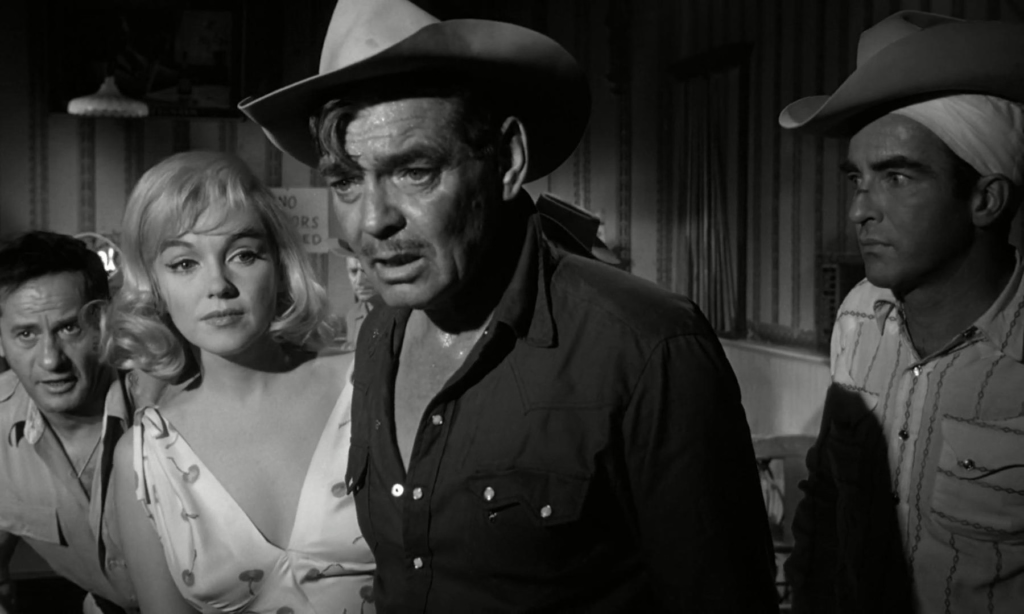
Standing behind a laced curtain, shot from a low angle: this is how lead female character Roslyn Taber first appears – and indeed she could well be looked like an apparition to the first man of the narrative stumbling upon her and right away falling under her spell, Guido. The camera takes his point of view: he is next to the implausibly battered car she uses, taking stock of the damage and assessing what it could worth on the driveway, while she is in one of the bedrooms a chirpy and candid middle-aged lady, Isabelle Steers, lets to the kind of people Roslyn Taber belongs to – one of those women, and men, coming to Reno to get a fast-tracked divorce. But it turns out to be a rule: soon the audience would realize the camera nearly always hovers at eye level or relishes in striking low angles. Rare would be the high angles. As rare, by the way, would be the long distance this first low angle uses: the camera would soon, and permanently stays as close as possible to the characters’ faces, sometimes, if tension rises too high and the place is too tight, conveying a slight claustrophobic quality to the frame.
This camerawork conveys the intensity, the fierceness, of sentiments, but also the fun, the excitement, sometimes the fright too, Roslyn Taber’s journey into the wild of Nevada stirs, in herself, in the men around her, in their interactions. Mark the dancing moment in Guido’s unfinished country house is an alluring and riveting performance, the closeups capturing then the lust tinged with admiration that Guido and his pal Gay Langland feel for the blonde, the strain between happiness and fear of happiness wrecking Roslyn Taber, and the low angles shots capturing the pleasure of Isabelle Steers to take part in what is a completely laid-back and carefree moment of chummy fun, with the occasional and striking high angle shots capturing the frantic, if comic, steps of the dancers, pointing to Roslyn Taber’s natural talent and emphasizing Guido’s steely determination to conquer her. This vivid and mirthful sequence, however, ends with an awkward note, as a too drunk and excited Roslyn Taber teeters and some tension hanging in the air around the men.
More is to come, the same kind of ebullient and boisterous meetings, with comical moments. Think of the boy getting drunk by accident in the bar where the leads gather with another partner, lone cowboy Perce Howland before a rodeo show where he gets enrolled (and where Gay Langland hoped to find the guy he needs to capture horses) and other great shots full of energy and fun, till an incident spoils the atmosphere and throws the characters in a despondent state, or simply in daze. The spectacular and inspiring mise en scène strives to delve deep into the zest and drive of the characters as well as the whole folksy and vibrant atmosphere around them and to record a vivid and dramatic stream of life even as its force hits limits. And that is part of their fate as misfits: bursting with energy and desire and expectations and pleasure but in fact badly struggling to come to terms with flaws, problems, a world where they fail to carve up a space and to get a sense of security, a vision of the future, a true happiness whose outside features they try hard to grasp from what they get from one ride to another, from one adventure to another, from one binge to another.
The visual and narrative climax of this tension is reached in the most arid plains of the state, in the quiet and void the wild can impose on mankind – an astonished Roslyn Taber would note that the fluttering of the clothes on bodies can be heard in such a silence as the one hovering over the patch of desert where the men took her to witness how to capture Mustang horses. The dramatic, and dramatically shot, capture of the wild beasts is remarkably gripping and exhilarating, a visually splendid show of skills and a truly Western performance, but the spat between Roslyn Taber and Gay Langland the night before has already deprived it of any feeling of excitement and fun and the more the men prevail over the beasts the more, through its astonishing and telling closeups, the camera points to a crisis to come. It expresses in the barest terms troubles that have already made the interactions so unwieldy and uneasy.
The trouble of Roslyn Taber lies in a constant fear of getting it wrong again in a love affair and her urge to give love a chance again, the tension between how desirable she is, and aware of being, and male attitudes she does not know whether to trust or not, to accept or not, to live with or not, an upsetting, fascinating reflection on the complicated life of the real actress, Marylin Monroe, the idol famously unhappy in love affairs, the pinup longing for seriousness, the blonde so proudly alluring and yet so truly insecure, courtesy of a screenwriter who is her husband, playwright Arthur Miller, whose text she never liked even as she was shooting it, one of the many hitches famously cursing this new work of director John Huston.
For her men, the strain is different. The tale of Gay Langland, Guido, and Perce Howland tells how rough and tough men fed with the West’s old values and habits flounder not only to reach out for a sentimental happiness the body, candidness, and kindness of Roslyn Taber dangle before them but also to carry on with their work ethics, their reckless free state of mind, the savage independence their lives have been built on. It is of course too late in the Unites States of the early 1960s to have the life they could have got just a generation earlier. Their fear of wages, that is to be employees of any modern-day business, even just a fast food joint, and their thirst for danger and wandering drive them relentlessly to get stuck in financial dead ends and drowned by futile efforts. This is what makes the Mustangs sequence so poignant and absurd: all those risks, including losing the girl, for just six horses, including a foal, and a possible gain of 110 or 120 dollars. Under Roslyn Taber’s gaze, if not her influence, the three mates, each on his own terms, are forced to grapple with some depressing truths.
Gay Langland, an aging Clark Gable carrying in his wrinkles and in his distinguished and sporting attitude fond memories of a bygone era of filmmaking thriving in part in westerns and period pieces, stands as the old and proud cowboy who cannot give up, only to accept his fate, which turns out not to be so bad in the final shot – after all, Gable and Monroe, despite the gap between them in age and in cinematic personae and past, manage to present a romantic image of a couple set to last (poetic, if mawkish, pictures of stars by night, help, but the reality would be far somber, with Gable dying soon after the shooting and Monroe killing herself less than a year after). The case of Guido is far more harrowing: a widower and a veteran of the Second World War, and the first to have spotted Roslyn Taber, he proves to be the most stubborn and peevish of the lot, the most unwilling to give up on the cowboy business, the most angry after a girl who has never been really tempted to stick with him. Played by Eli Wallach, he carries the bitter memories of lives upset, if not broken, by the war, and struggles to secure opportunities in a fast-changing postwar nation, including in cultural terms (time was coming for the counterculture, not for western nostalgia).
Young Perce Howland’s case is yet another matter, as suggested by the readiness of the camera to shoot actor Montgomery Clift, in a poignant performance, in high angles, especially during a key conversation with Roslyn Taber. He would rather come straight from a James Dean film: a charming but drifting, tormented, impulsive young man whose relations with his family are badly strained and who wants to assert his independence and his personality however inchoate it is. He is psychologically the closest to Roslyn Taber and intellectually the more realistic of the men, which explains why he was so reluctant to capture the horses and the keenest to set them free. Quite a moving character, he is nevertheless dropped out of the story swiftly, ignored by the blonde who paid so much attention to him but was more attached to Gay Langland, left to his own devices even as Guido gets stuck in his groove. Misfits those men look set to stay – not everybody can meet a happy ending, not even in a film, let alone in real life. And Huston, always fascinated by the futility of virility, observes that hard fact handsomely.