
Germany, 1929
Directed by Georg Wilhelm Pabst
With Louise Brooks (Lulu), Fritz Kortner (Ludwig Schön), Francis Lederer (Alma Schön), Carl Goetz (Schigolch), Krafft-Raschig (Rodrigo Quast), Alice Roberts (Gräfin Geschwitz), Michael von Newlinsky (Casti-Piani), Gustav Diessel (Jack the Ripper)
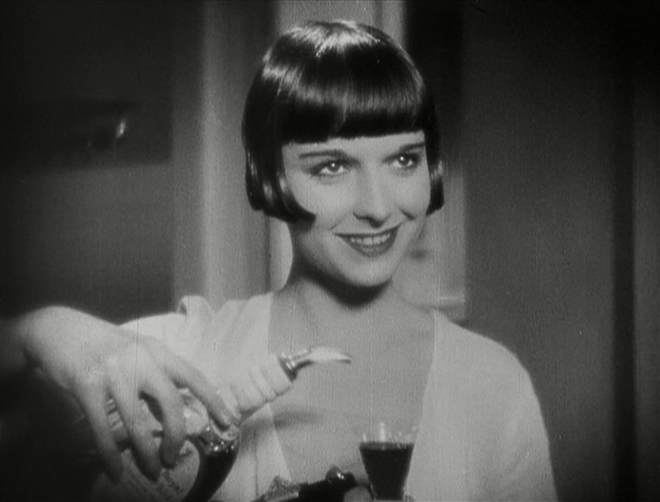
The not very young, rather distinguished, tranquil, diligent worker, with his nice wrinkles and his great white mustache, is checking the electricity meter of the swanky apartment. The apartment’s tenant looks at him a bit worried but eager to charm him. And so she does: with her incredibly bright, beguiling smile and her lovely sparkling eyes, her youthful cheerfulness and her effusive politeness, and a tempting bottle of liquor, she bewitches the fellow who looks at her with twinkles in his eyes hinting at an unseemly arousal while smiling sillily. But nothing more pleasant is going to happen: a smaller, uglier, shadier character rings at the door and is enthusiastically hugged by the lady with fashionable dark hair and a sophisticated white dress.
Briskly and smartly edited, with arresting closeups conveying the beauty and magnetism of the woman and the astonishment of her first visitor, who nearly forgot to cash the money she owed him, and perhaps did not get all that was owed, the first sequence of the film brilliantly and powerfully puts on the center stage a lady like no other, a buoyant and bold, marvelous and mischievous, trendy and teasing young woman fully belonging to modernity. A fascinating new feminine allure is imposed – but this overwhelming presence raises immediately the question of her power, its extent, its motivation, and the consequences it can have.
The smirking, disheveled, eccentric old fellow who rang the door suggests questionable relations and a few skeletons in the cupboard. Schigolch is presented as a former master by a woman who visibly used to be an entertainer – though not a first-class one. The man would keep lurking around Lulu, a discreet companion unable, and unwilling, to stray from his protégée – unless their bond is deeper, Lulu once claiming in panic as his life is on the line of fire Schigolch is actually her father, a claim that is never repeated and that, if not completely far-fetched, does not sound very compelling. He does not show up alone: he is accompanied by a friend of his, a showman intent on creating a cabaret number with Lulu, Rodrigo Quast. The stout fellow would also regularly come back in Lulu’s narrative, increasingly less comical and more brutal: his dubious plans also hint at a section of the show business and the wider society far seedier and harsher than what the nice sprawling comfortable apartment of Lulu signals.
But then it is not hers: it has been bought for her by a wealthy and influential lover who is introduced nearly as quickly as Schigolch but with far more sober and dourer notes. The bourgeois is stern – and embarrassed. Ludwig Schön is the renowned editor of a big newspaper. He did enjoy his affair with Lulu but now wants to get married and has chosen an aristocrat whose father is the country’s interior minister. Carefree Lulu struggles to come to terms with a decision that looks unassailable even as she wields again her charms. At least that unexpected change prompts her to think seriously about dancing again on stage.
It is not, however, the offer of Rodrigo Quast and Schigolch that she takes, but a project by her best friend, who is a music composer but also the son of her lover, Alma Schön – in fact, the young man has been talked into picking Lulu as a lead performer by the older, who is distrustful of the lady he has left but clearly still hopes the best for her and remains fascinated by her seductive appeal which, he rightly fears, obsesses Alma Schön. But if she was thrilled by the prospect of performing, Lulu out of the blue decides during the opening night that she cannot dance with her lover’s fiancée in attendance. She sparks a confrontation that she eventually wins in her cunning and provocative terms: she manages to kiss and to pet the incensed Ludwig Schön who mellows – and who is found out in that awkward situation by the son and the fiancée.
The scandal is so huge the editor must give up on his marriage plan and instead tie the knot with Lulu. The party following the wedding, however, becomes another raucous nightmare causing a new scandal, mainly stemming from the cheeky and inebriated behavior of Schigolch and Rodrigo Quast. Ludwig Schön gets angry again, but at a more dangerous and desperate level. He tries to kill Schigolch, then considers killing himself, before forcing Lulu to kill herself. But as they fight a bullet is accidentally shot: Ludwig Schön dies.
A police inquiry and a trial follow. Once again, wonderful closeups and clever editing emphasize the power of Lulu to charm and to unsettle. She is still sentenced to five years of prison for manslaughter. Her shifty partners, aided and abetted by her closest female friend, Gräfin Geschwitz, and a besotted Alma Schön.
The free spirit is now on the run: but the thrill of fresh adventures, which at first includes a lucky meeting with an Italian aristocrat, Casti-Piani, who refuses to snitch on her but instead offers to shelter her and her lover Alma Schön, gives way to constant torment and quandary, aptly signaled by a complete change in her haircut and a paler and more worried face. Poverty trails her, her lover, and her small gang of pals still in tow. The generous Italian proved another dubious character running a gambling den and reckoning to sell Lulu to a rich Tunisian while Rodrigo Quast keeps dreaming of entertainment successes and gets ominous because he is not given the dough he needs. Events quickly take dramatic turns that are tantamount to a relentless and horrific downward spiral.
The final act takes place in the squalid streets of London, in an attic full of drafts and deprived of amenities. What Lulu did not want when it was imposed by Casti-Piani is now the unavoidable sacrifice to allow a sick and distraught Alma Schön and a Schigolch oddly still zesty and solid to survive: Lulu starts to be a prostitute but her first client turns out to be the last, the nervous and withdrawn man, as suggested by a street poster and the flash of blades, is a serial killer, the Jack the Ripper kind.
The face-to-face between the seasoned murderer and his next victim is stunning. It stands as the last time the camera scrutinizes and showcases the twinkling eyes of Lulu and her winsome smile, her sheer beauty and her intense appeal, her eerie but mesmerizing knack of casting a spell and at the same time looking so concerned and loving. It is as if everything were still possible, as if nothing could undo her charm, as if she could really deliver redemption and save his soul, her soul, all souls. The man is shot as deeply troubled and frantic, torn apart by impulse and vision. But her darker side could not be tamed: the horror, nevertheless, is not in full display and only a hand of Lulu, becoming slowly numbed and then slowly dropping away from the part of the man’s back where it rested, indicates her death. The real horror, arguably, comes after, when the camera follows the killer moving back to the street, casting a glance at Alma Schön who was loitering and then, instead of going upstairs, drifts in the streets, while Schigolch devours a Christmas pudding.
The men keep walking down their troubled path while the dead body of a woman who mattered so much and held so much power starts rotting. She was like a diamond, a phenomenon, a black angel too: but she was not set to shine, to live, to torment for a long time – just an appearance astonishing the world the time a few reels are projected. Till the tragic outcome of a drift further away from a cherished luxury and the fun of a relation she shapes with her mischief and her body, Lulu remains opaque: what her childhood and background were has never been clearly explained and what motivates her is hard to grasp. At the same time, Lulu has consistently cast as a riveting and radiant character, a seductive power impossible to ignore and also to condemn unreservedly. She cannot be trusted but she cannot be kept at bay. She may first come across as a gold digger but in the course of their fall from grace she is truly loyal and mindful to Alma Schön.
But under the lens of director Georg Wilhelm Pabst the character invented for his play by Frank Wedekind is first and foremost a towering and lively modern figure. Lulu is the perfect flapper, proudly unconventional and carefree, magnificently stylish and candid. But with the help of the stare and the radiance of actress Louise Brooks, she also emerges as a new, irreligious, dreamlike icon, the very kind that only cinema is able to shape and exhibit. Pabst wanted dearly Brooks for the role, even rejecting Marlene Dietrich: for sure, he did know what he could draw her and the result is terrific. His Lulu shines, troubles, and pities even more as she is thrown into a morally failing world of men captured by a sober realism. This is cinema, technically and artistically, at its best, the feature of a confident and inspired filmmaker.