
United Kingdom, 1964
Directed by Joseph Losey
With Dirk Bogarde (Captain Hargraves), Tom Courtenay (Private Arthur James Hamp), Peter Copley (the court martial colonel)
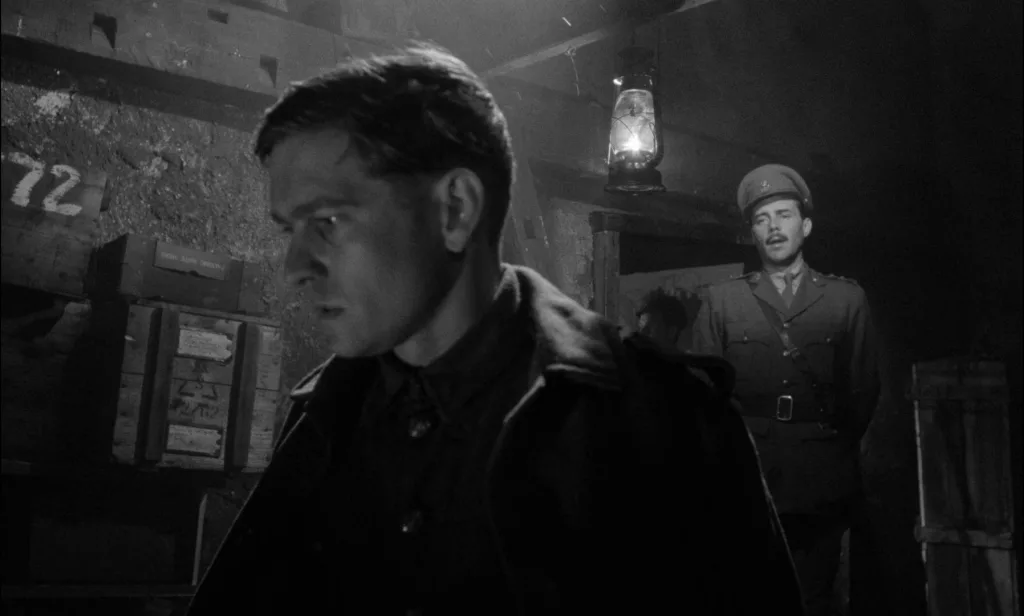
The great idea, perhaps, is the gang. The film is not just the straightforward account of a court martial trial, from the first interview between the defendant, Private Arthur James Hamp, and his appointed lawyer, Captain Hargraves, to the execution one rainy dawn, in the mud of a trench, as the troops are set to move again, with the members of the firing squad missing so badly, perhaps deliberately (the point can be made thanks to a rather bold and perplexing POV shot), the soldier that his lawyer is forced to give the final shot, the coup de grâce, making sure the man, sentenced for desertion, dies.
The ordeal of Arthur James Hamp, from the start, is only one part, though the bigger, the more important, the more emotional, of the feature. The editing deftly switches from the tragic and meticulous chronicle to the routine and antics of other privates, unfolding as the trial unfolds, as soon as the lawyer arrives till the fatal dawn. Unnamed, nearly always shot in group, with rather few close shots on the individual face, those characters bring to mind the chorus of the ancient Greek tragedy – with more ribald and elaborate touches.
Uttered in typical lower-class British, the gang’s simple words and cynic witticisms and their down-to-earth pronouncements and provocative statements deliver context, commentary, mockery, fatalism. The audience is warned against entertaining much hope – Hargraves is no white knight and would find it hard to spare Arthur James Hamp the worst – but invited to watch the proceedings as a mere theater – indeed, the gang, to have fun and to vent frustration, puts on trial a rat at the same time as the trial of their mate reaches a climax and thus exposes the rigmarole as ridicule – which, alas, is part of wider travesty of effort and glory – it is no coincidence that the group is first shot not training, even less fighting, and not even cleaning the weapons and uniforms or any other tool or instrument, but simply getting rid of shit in a muddy hole.
Trenches are no better than sewers, the camp is simply a maze-like mess mired in muck, ordinariness is an illusion, the promised glory, for the sake of a kingdom and a king who, after all, is part of the same European aristocracy as the emperor ruling the enemy, is distant. The only thing that rings genuine and that the gang is quick to defend and to illustrate is camaraderie. Of course, there is also death that is a concrete reality, always within reach – and Arthur James Hamp would get it outside the battlefield, that is all.
It is precisely because the not very clever private wandered, exhausted, fed up with too much blood and too much chaos, distressed, far away from the battlefield that he ended up in a jail. Arthur James Hamp is first shot lying very quiet and unaware of the mess where he has boxed himself in. The more he is shot and the more he speaks, fumbling for the right word, feeling insecure because he deals with folks who had a better education and rank higher in the military hierarchy and the social one – on the Civvy Street he is a cobbler from a popular London neighborhood – the more it is obvious he cannot but find it hard to grasp fully the consequences of that stupid stroll started out of the blue and absent-mindedly. His tragedy is the clash between a simple mind who foolishly blundered without knowing really what prodded him and what he intended to do, and the rigid rules of a military hard-pressed to deliver victory and considering men as expendable. When the sentence is handed out and read to him, of course, the fall is dramatic – he does fall on his knees – and the poignancy is overwhelming – the high angle shot is more arresting than ever.
Actually, high angle shots have always been. From the start, the first images of Arthur James Hamp blowing into his harmonica or the frantic apparition of the gang shoveling away human waste, the camera is set on a high point and trained to the bottom: an amazing number of scenes are shot this way, entirely or in part. The sentiment that the audience is observing little men moving around helplessly in a daunting, depressing, dark frames is blatantly dominant – that this war was a trap catching a mankind in the depths of horror and absurdity is not just powerfully expressed, the notion is rubbed it in mercilessly.
Yes, there is little mercy to expect from such a war decided by those at the top of the unequal world and no mercy is offered to Arthur James Hamp – as none was offered to the dead he witnesses till getting shocked and those still littering the trenches and the environs. Yet part of the trial becomes an unexpected collision with mercy for those that think themselves better than those who fail, or just stand too low. The candid innocence, the genuine lack of malice, the heartbreaking struggle to put words and concepts on his past acts, and the no less poignant characteristics of the private’s mind, utterly naive and depressingly dim-witted – and what a great, greatly moving performance of actor Tom Courtenay it is – slowly erodes the blasé and supercilious ways first displayed by Hargraves. He started his interview as confident as ever and of course with contempt for yet another deserter: he ends it upset and eager to make another case than usual.
Hargraves does act brilliantly and bravely during the trial – most of his questions and his concluding plea are compelling and impressively delivered, actor Dirk Bogarde putting the other stellar performance of the film, on a more classy and intellectual level, captured by striking, fiery closeups – and can rightly feel sure he is going to spare his private the worst. Shots and reverse shots have critically underlined the impact his words and his client’s slowly had on the colonel presiding the court martial, his two younger deputies, and the court’s dashing law counsel. But their faraway commanders could not entertain a simple jail sentence: to them justice must be exemplary, only to teach the troops the right lesson the right way. But is such a death penalty truly inspiring – has the death penalty ever been effective? A tragic touch inside the wider tragedy is brought by the answer of the colonel to this bitter question asked by Hargraves: of course, no, but orders are orders – and the life of a man, the fairness of a trial, the most important questions (what does it mean to be shell-shocked and to suffer, what does it mean to be loyal and disciplined) do no matter much when part of the orders is to move the troops away immediately, to fight further afield for that elusive victory.
A final merry touch comes with the last hours before the execution, when the gang stealthily enters the cell where Arthur James Hamp is waiting with jars of wine. Getting drunk one last time, fooling around one last time, showing camaraderie one last time is after all all that is left for the prisoner before the horror. The scene is long, clashes with the drama that preceded it, even strays from the antics of the gang: under the provocative fun lies a sense of friendship, of humanity, of love of life, of wild liberty that even the most unfair trial and the most scandalous war cannot stifle for long.
The titles appeared on closeups on a monument dedicated to war dead, with the camera roaming up close above the white low reliefs, before giving way to file photos of the real war, and then moving back to watch rain falling on ponds and widening the scope to reveal a trench. In a way, it seems an elegant chronological move backwards, from the audience’s present to the reconstructed past, the audience quietly brought back in time to watch a genre movie – which happens to be very close to Stanley Kubrick’s 1957 “Paths of Glory”. On second thoughts, the beginning of this equally gorgeously shot in black and white flick has is far more scathing than that: director Joseph Losey pointedly proposes to move away from the reverence expected by the powers-to-be and patriotism for those who gloriously died in battle to a vivid and upsetting observation of the senseless sacrifice that those deaths have really been, the ugly reality of men whose failings, pains, troubles, also joy, dignity, had been so dutifully dismissed, for the sake of the King and the Country.