
Italy, 1914
Directed by Giovanni Pastrone
With Carolina Catena (Cabiria as a child), Lidia Quaranta (Cabiria as a young woman aka Elissa), Umberto Mozzato (Fulvio Axilla), Bartolomeo Pagano (Maciste), Teresa Marangoni (Croessa), Dante Testa (Karthalo), Italia Almirante-Manzini (Sophonisba), Vitale Di Stefano (Massinissa), Luigi Chellini (Scipione)
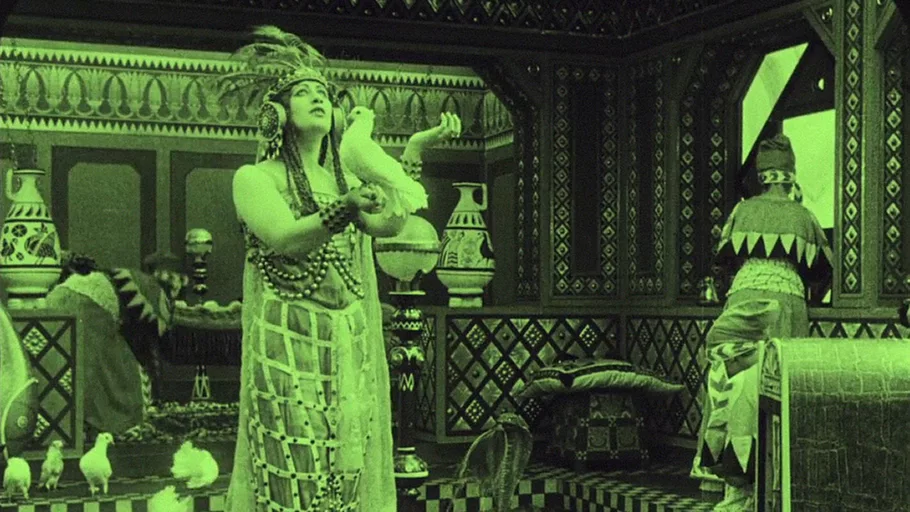
As the new art of cinema – or the new industry, or just the new mass entertainment, nobody was sure back then how to qualify what was going on with that invention supposedly deprived of a future according to the Frenchmen who contributed so much to it – was developing, spawning countless shorts but increasingly features, Italy engaged in a very specific genre, a stunning sort of production, blockbusters before this term gained currency. Those movies were based on mythology and religion, the epic nature of both the plot and the characters, and a taste for grand reconstruction of the Antiquity; they were costly period pieces showing off pseudo-historical costumes and lavish sets made with outstanding skills, with sources ranging from Dante Alighieri to the Gospels and an impact that was huge not just in Italy but through the world, effectively setting the low-cost and imaginative Italian movie business at the forefront of the silent era. Some of those films involve the 1911 masterpiece “L’inferno” directed by Francesco Bertolini, Giuseppe de Liguoro, and Adolfo Padovani or “Gli ultimi giorni di Pompei – The Last Days of Pompeii” directed in 1913 by Mario Caserini and Eleuterio Rodolfi.
A volcano wrecking disaster is also at the core of the first episode of this 1914 awesome production. The tremors and the lava of the Etna disrupt in fiery red and deeply realistic images the quiet life of a patrician family the film started to display. The house is partly destroyed and the servants discover a secret room where their master hoards his wealth. They steal as much as possible, thinking the master and his wife are dead, and run away. They end up captured by pirates and sell to slave owners after sailing to Carthage.
Among the unfortunate group there is Croessa, the maid looking after her masters’ daughter and the girl herself, whose first name is the film’s title. Croessa, along with Cabiria, is also successfully sold, but to the high priest of the city, Karthalo, who intends to use the girl in a sacrifice, to the woman’s horror. Luckily, Croessa gets in touch a fellow Roman who happens to be in the city and is a free man living with his slave. There is a reason for the presence in the rival city to Rome of Fulvio Axilla: he is a soldier now working as a spy. Touched by the plea of Croessa, he accepts to save Cabiria with his slave Maciste even as the sacrificial ceremony is taking place. The kidnapping is a nail-biting and highly spectacular action scene but the thrills lead to tears: Croessa and Cabiria cannot be reunited. The woman ends up arrested and executed while the girl must be trusted to an aristocrat Maciste stumbled upon by chance as he was running away from soldiers and she was expecting a secret lover.
Safe but kept from sailing back to her native Rome, Cabiria grows up becoming the personal slave and maid of the woman who took her and how is the gorgeous and haughty daughter of Carthage’s king, Sophonisba. But the film gives only a cursory look at her story, rather focusing at length on the adventures of Fulvio Axilla and Maciste. Caught, the strapping and forceful slave is sold to a trader using him instead of cattle to turn his flour-producing millstone. A free man living back home, the dashing and gusty soldier gets involved in the Second Punic War, from 218 to 201 BC, facing in particular the bold attacks of the foreign troops.
Both get reunited after the war when Fulvio Axilla goes back to Carthage as Roman troops set foot on the lands of the rival state, eager to know the whereabouts of a companion he liked so much and felt so close. Alas, they roam together freely the city only for a short time before being nabbed. However, the time spent in the royal palace’s jail allow them to discover what has happened to Cabiria, who is now known as Elissa and whose beauty attracts the lustful and still powerful and cruel high priest of Carthage. New stunts and twists and turns sweep the silver screen as wider political events wreak havoc on the city, with the Roman general Scipione negotiating with the king of Numidia, Massinissa, the African leader who once went stealthily to Sophonisba’s private garden to seduce her, then vowed to marry her, but eventually betrays her kingdom. The distraught princess commits suicide. Even as her kingdom collapses, Maciste and Fulvio Axilla rescue Cabiria from another attempt to sacrifice her and in the wake of Scipione’s triumph the three can sail back to Rome where the soldier courts the lady under the gleeful stare of a panpipes-playing Maciste.
This final romantic flourish, delivered with yet another set of special effects and a bartering edge, stands as an effortlessly, though highly effective, delightful and crowd-pleasing happy ending but does not wholly reflect the broad tone of the film. It is an unabashedly and boundless entertainment deeply entrenched in the logic of a genre, only playing the rules even more ambitiously and amazingly. Sets are simply even more spectacular, complex, and gobsmacking than usual, with fire the spark of the wildest side shows. If the Etna eruption is both arresting and a first, poignant, turning point, the attempt to sacrifice a young Cabiria drives the crew to build extraordinary oversized sets where flames deliver fears and wonders and gripping stunts capture the imagination. As war unfolds on various grounds, fire keeps dazzling the audience by creating gripping and terrific scenes of chaos where fate for a time look uncertain, ensuring suspense remain high.
Dreams also drive the film to show, with the technique of superimposed images, magical special effects that illustrate vividly the tragic fate of Sophonisba or the romantic expectations of Fulvio Axilla and Cabiria. Those awesome images are the terrific creation of a duo, Eduardo Bava and the Spanish cinema pioneer Segundo de Chomón, whose contribution was not only essential but precious evidence of how transnational filmmaking was already in the silent era. Equally praiseworthy and extraordinary is the work of director Giovanni Pastrone who does not content himself with framing the most efficient and most precise way the dramatic scenes: he insists on injecting movement, on making the camera widening or shifting the frame to boost the impact. And so the audience of 1914 are treated with stunning shots that for today’s audience have long been the usual stuff, the tracking shots, mainly tracking out ones but also lateral ones. “Cabiria” is arguably the first feature film to use a dolly camera – an improvised tool that was right known as a Cabiria.
Based on the essays of Livy and novels by Gustave Flaubert and Emilio Salgari, the screenplay has been in part written by Gabriele D’Annunzio, who helped flushed out the character of Maciste who would proceed to become a recurrent lead character in the Italian cinema for a long time. It adroitly anchors the tale of Cabiria and her saviors in a wider historical context, allowing for all the spectacular, stunt-filled, artistically splendid scenes the audience no doubt enjoyed back then highly, and can still like today, even though it makes the narrative feel at time a bit too rambling. But this two and a half hour prestige production cannot be considered less than groundbreaking and compelling – and this was readily acknowledged at the time, including with a special screening at the White House in Washington, DC.