
United States, 1951
Directed by Billy Wilder
With Kirk Douglas (Chuck Tatum), Porter Hall (Jacob Q. Boot), Robert Arthur (Herbie Cook), Richard Benedict (Leo Minosa), Jan Sterling (Lorraine Minosa), John Berkes (Papa Minosa), Frances Dominguez (Mama Minosa), Ray Teal (Sheriff Gus Kretzer)
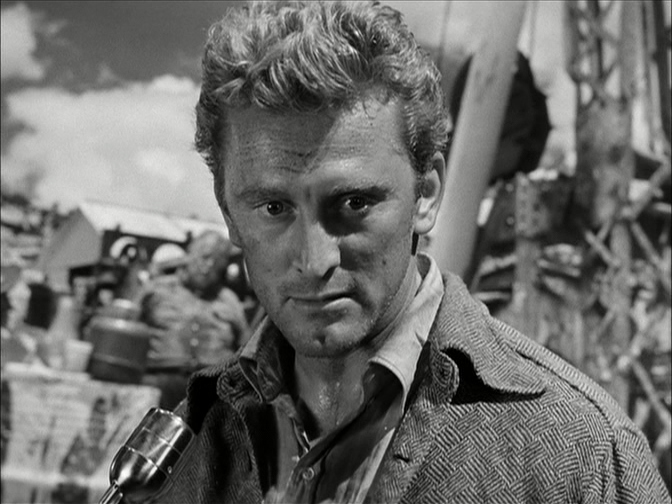
The cocky and angry journalist, who stepped into the building of The Albuquerque Sun Bulletin jobless and penniless, exits the office of the paper’s publisher and editor Jacob Q. Boot with a position and the burning desire to make it. He walks straight to the place where the camera stands, a muscular body in a dapper suit relentlessly stepping forward till it obscures the camera’s eye. Nice way to use swagger and drama to fade out a shot and end a sequence. Then a new shot fades in, with a reverse move: the body that obscured the camera’s eye walks away, a muscular body in casual clothes stepping to the back of the set, hinting at a desultory attitude. Then the guy stops moving, turns around, and starts raving and raging. Chuck Tatum bemoans he has still not got the scoop he yearned for, and is still stuck with little to do in the newsroom of this local paper. His ordeal was supposed to be a matter of weeks: in fact he has lost a full year, no less.
As a time ellipsis it is an impressive trick: the shooting and editing prove to be strikingly smart and bold, the film quietly jumping over a year, the time, on the reel, for a man to walk the other way around in an office. What the audacious and beautiful cut conveys is the increasing rage of a brazen and ambitious news reporter unable to break his bad luck and to get back on the top of the trade. It also points to a daring, unusual way of dealing with the timeline of a narrative that eventually makes it more shocking and riveting.
Sent to report on a local snake festival with the paper’s young photographer, Herbie Cook, Chuck Tatum stumbles on a remarkable incident: the owner of the gas station cum souvenir shop cum motel where Herbie Cook must pull up their to fill it turns out to be trapped deep in a nearby mountain. Leo Minosa was looking for ancient pottery from the local Native American tribe in a complex of tunnels and caves, but he went too far as some beams and pillars crumbled. Eager to fetch nice things to show and sell, he lies now under rubble in a cave that is in part blocked by heavy rocks. His father, Papa Minosa, and his wife, Lorraine Minosa, try to bring to him food and coffee while the Native American folks look on dissatisfied: they view the mountain as a holy place and do not tolerate the white man’s obstinacy and greed. Nobody seems to know how to help Leo Minosa. Undaunted and cockier than ever, Chuck Tatum goes under the mountain, to bring the food and the coffee, to talk with the fellow, and to assess the situation. To him the trouble of Leo Minosa means a spectacular rescue operation for an unlucky but brave and sympathetic regular guy, to be undertaken fast, under pressure, despite risks, in the shadow of a curse (thrown by the Indian spirits living in the mountain of course). In other words: Chuck Tatum has the great story he has so fiercely hoped for.
And he soon takes initiatives to make himself the indispensable man, for Leo Minosa and for a community ready to help the victim. Too much initiatives, in fact: despite his claims to Lorraine Minosa, who is even more hard-nosed than the journalist, and views the tragedy as an opportunity to take the French leave, fed up with a dull and unsatisfactory life, he does not care blurring the lines between reporting on the facts and creating them. With the help of the local crooked sheriff, Gus Kretzer, he compels an entrepreneur to drill the mountain from top to bottom to reach Leo Minosa, instead of just shoring up extant tunnels, only to make the ordeal of the trader longer – the longer it lasts, the more anxious people get, the better for a reporter wanting to fill as many reports as possible, and really lurid and stunning reports, of course.
But it is not with paper clips, shots on a calendar, talks with Leo Minosa shot in a clearly regular, ritualistic way, or any other routine repeated with enough variation to point explicitly to a new day that the course of time is marked in the film: the director cleverly and provocatively has decided that the flight of time is not going to be stated and heralded by such predictable features, at least not all the time. What he shows day after day is how the ground around the mountain gets crowded – and how it all comes about.
It first starts when a little, typical American family on their way to their vacation spot show up to have a look at the story that caught their attention as they picked up a copy of the local paper. Then other families come. Then it becomes a community camping out in front of the mountain. The tragedy has become an attraction, stoking a media frenzy and feeding its own attractiveness. A day after another, the camera, clearly invited to do so by a radio reporter, pans over the plain, taking stock of the constant increase in the number of people and in the business activity they feed – a circus would even come and pitch its big tent, a development the camera eagerly observes, even as a side shot shows how dismayed Papa Minosa feels. And when the worst does happen, the camera records how the tent is dismounted, how folks pack up their belongings, how cars drive away in long lines from the plain that is now a burial ground.
No wonder that the film was right away and for quite a time afterwards poorly received: “Ace in the Hole” stands as the most scathing and brutal examination of that essential element of media frenzy, the concrete reaction of the public, how they respond to a news item and how they decide to make it a popular event, a rallying point for a curiosity caused by the media but shaped by raw emotions and the gregarious need to attend an event and be part of it.
The tragedy, which at the start is just a minor and pathetic incident that could have been handled quickly and rather safely, becomes a most heartbreaking, horrible, scandalous situation because a selfish reporter made a rescue operation far more longer than it needed, eventually endangering the life of Leo Minosa. Playing with time, creating a senseless race against the clock that was in fact a dangerous manipulation of what a body can bear over time, Chuck Tatum has shorten a life – as he himself acknowledges, assassinate a man. But the film does not just examine how things get out control, even as it does the job with intelligence and flair: it emphasizes how people responded to the willfully distorted drama. Granted: they were not aware of the reporter’s shenanigans, unlike Jacob Q. Boot who soon guessed something was fishy. But they were glad to attend the show these shenanigans created, to be thrilled spectators lured by the pain of a man and the swagger of those claiming to save him. The film is the rigorous chronicle of a mass reaction and underlines consequently the role of the audience, how key to media success and legitimacy they are, the responsibility they should take. The story of Chuck Tatum is downright ugly and his fall unavoidable – and it does occur in the most concrete way in the dramatic final shot of the film. But nobody can be spared in fact, and how ordinary people shamelessly and foolishly behaved cannot be forgotten, even less forgiven.
The most poignant images reflect the real pain of the parents of the dead: Papa Minosa, wandering alone in the now deserted plain, mourning his son as everybody moves away, and of course Mama Minosa who has prayed and cried all along the narrative, hoping God would not let her down and spared her son. These are the real, humble, respectable, natural faces of anxiety and grief – they are a world away, and shot as such, from the improvised and sentimental community strangers dared to set up. The satire, which actually does not offer much punchlines and comic situations, rather basking in blunt and outrageous scenes which rely more more on cynicism than wit, is an unforgiving view of the media consumer, and the wider media cycle.