
United States, 1948
Directed by Billy Wilder
With Marlene Dietrich (Erika von Schlütow), Jean Arthur (Phoebe Frost), John Lund (Captain John Pringle)
The comic plot is thin and facile. It centers on an awfully righteous and rigid lead character traveling to check if their fellow countrymen live according to their nationalistic prejudices and priggish standards while stationing in a former enemy country – and thus are kept immune from any temptation. Alas, it is not the case and making a head roll becomes the pressing concern. But finding the guilty part lands the lead into a romantic confusion doubling down as a political mess.
Such a summary suggests Billy Wilder the director is revisiting the work of Billy Wilder the screenwriter who helped fellow German-speaking Hollywood exile Ernst Lubitsch to make the memorable political comedy “Ninotchka” in 1939 (the film famously showcasing Greta Garbo splitting sides). As the new plot progresses such an idea looks right. Yet differences are crucial, if only because of the shooting’s era and circumstances.
This is no longer a gentle and genteel Hollywood entertainment with America as the background and the ideological and romantic battleground shot while the competition with the USSR looked fierce and the war with Germany an hypothesis. This is an exploration of a ruined Germany after the many disasters and horrors of a world war, with, as the credit sequence emphasizes, shots made on the German soil and it not really a competition between equal rivals that is put on the spotlight but the mess inside a camp that has won and is rightfully, and awkwardly, occupying the losing camp.
The same year this comedy was released Roberto Rossellini offered another neorealist landmark also shot in Berlin, the poignant “Germania anno zero – Germany Year Zero”. Between these two ideas of a film lies a gulf, stylistically speaking, in part because the aims of those productions could not have been more starkly antagonistic. Hollywood would not ignore the reality of a defeated nation, but neither would it allow itself to deliver a strictly realistic vision that would have meant grim pictures and grimmer developments. And of course happy ending was a given, as much as a positive spin on the American institutions – it is not they must be spared any criticism, and they got their fair share with films by Frank Capra for instance, but after all this is about the army reeling from a huge and exhausting effort across the continents and basking in the glory of the victory of liberal ideas and human rights (never mind colonialism was not yet quite dead in that supposedly saved planet, or the racial segregation at home).
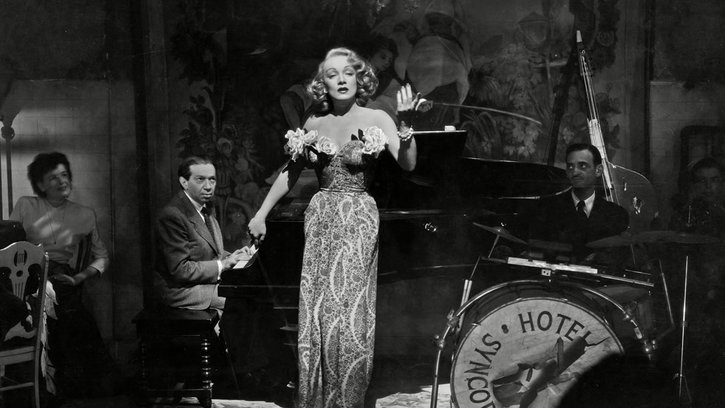
The conclusion delivered after nearly two hours of laughs artfully laced with sober commentary and edged with a withering sarcasm is therefore unsurprising. The besotted Congresswoman corners the sly captain to force him to engaged to her, her drive looking irresistible and his filibustering hopeless while the sultry singer, smart aristocrat, and former Nazi supporter is at long last escorted to jail. Probably the audience would rather watch the supremely seductive, sophisticated, and sage Erika von Schlütow keep strutting the streets, thrilling a cabaret’s customers, and loving the dashing and mischievous John Pringle, especially as her antagonist has long felt as an irritant. It helps Erika von Schlütow is played by iconic actress Marlene Dietrich, with all the film baggage she carries with her ever since she captured the world’s imagination with “Der blaue Engel – The Blue Angel” in 1930, more self-assured, riveting, mischievous than ever, playfully tinkering with her film persona and featuring in fascinating cabaret numbers.
Phoebe Frost’s belated triumph feels too conventional for what has been a pointed examination of deeply unconventional circumstances, actually a moral and political mess, revealing heartbreaking human realities and tragedies. However, the film, as it reaches the end, has long stopped depicting only on hard-hitting, ferocious, caustic terms the Iowa representative, whose family name first sounded like a bluntly advertised program that the plot development does implement merrily and mercilessly. The dour and tough lady, a fresh occasion for Jean Arthur to deliver a solid performance where hilarious moralism (the kind pretending never to be blinkered by some realities blinkers even as it allows itself to be dutifully blinkered to others) gently gives way to raw emotion, has, after all, let her guard down and embraced the concept of the sudden, wholly inappropriate, and delightfully intoxicating passion that she frowned upon so stubbornly. She has also paid the price for it. So she may deserves a reward. And of course, Nazism was unforgivable.
But the ribald twists and turns of the chase against vice is adroitly sprinkled by long lines that underline the dire straits of a nation on the wrong side of history and the complex navigation people must undertake to just survive and have a glimpse at happiness. The fatigue and frustration of the soldiers who have won and yet cannot go home right away, staying stuck in a foreign land they know little about, after years of dangers, is not just comically illustrated – think of the couple of soldiers riding their bicycle in the search of a mistress and stumbling upon Phoebe Frost – it is also poignantly articulated, the pith of an impromptu speech John Pringle ends up making to convince one more time the congresswoman not to look for more information on the cabaret singer he loves. He did not expect to utter the precise words and he would have to court openly and kiss savagely the lady to get her plan off the rails, only to find himself romantically trapped, but the moment is striking, as he conveys the weight of an experience those back home, in Iowa and elsewhere, may not be able to grasp fully.
And there is the lucid remarks of Erika von Schlütow, soberly telling both the congresswoman and the audience what life really is in the streets of 1948 Berlin and what it feels to be on that wrong side. The curse of black market is treated forthrightly, with a comic touch as John Pringle goes there early in the film, and in a far wittier and more provocative too manner in the lyrics of a song performed by Erika von Schlütow: after all, the film in the first shots on the former German capital displayed at length how widespread and terrible destruction is (prompting the visiting congressmen to make remarks that are, on second thought, not so much funny than embarrassing, though genuinely spontaneous). But the vexing situation of being always watched and disciplined by foreign troops is also highlighted as forcefully and not so comically.
Wilder is no Rossellini but within his remit and the entertainment’s limits he makes plain what his native country is experiencing in 1948 – and how in such a fluid and sinister situation moralistic judgments cannot but be idle (the middle-aged, seasoned, slightly cynical, always practical, still deeply humanist commanding officer of John Pringle could very well be the surrogate of the director within the fiction, far more aware of what cannot but happen in the people he commands and those whose land he occupies than those distinguished representatives of his own native country he openly mocks from the start). The rom-com is as sparkling as the genre demands but it is carefully framed in the dust of history – and it is not just a matter of skill and wit: emotion must have played a role in the making of this film and you wonder how Wilder and Dietrich coped with such a story some fifteen years after leaving Germany.