
Japan, 2013
Directed by Miyazaki Hayao
(Animated movie)
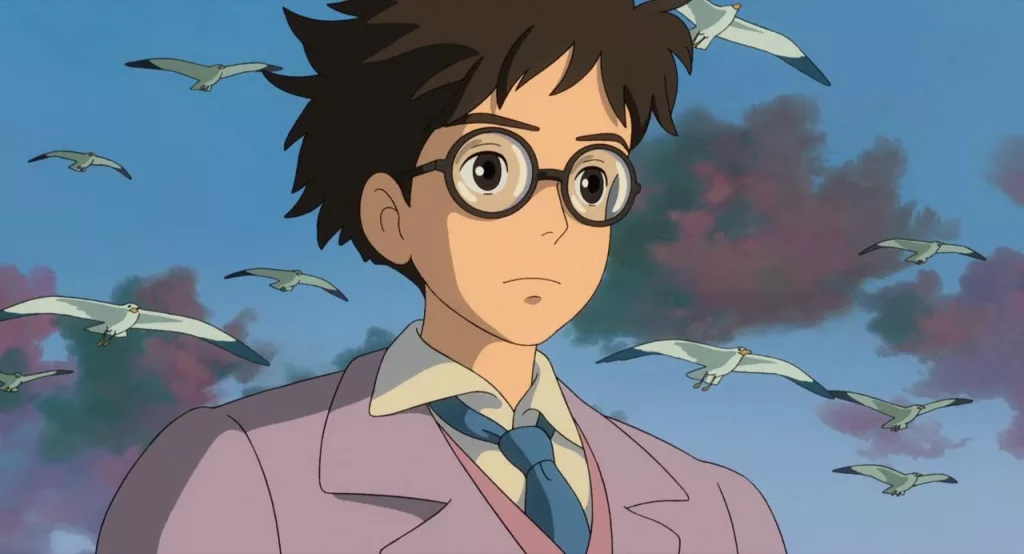
A boy is dreaming: his house has unexpectedly a plane on its roof, perched on a wooden structure at the top of gable, ready to take off. And off the young pilot flies, first high in the skies and then close to the ground, zipping below the bridges of a town to the acclaim of the thrilled people. But then other planes appear, ominously black, turning out to have odd, pulsating, terrifying bombs ready to drop. And down they go, destroying the boy’s plane and waking him up.
The film is about dreams we made that can inspire us, pushing us to take audacious decisions and embrace amazing projects, dreams we made that also, and oddly, can be shared with others, fostering a sense of common purpose, shared ideals, wide communion, dreams we made that wonderfully, and tragically, hint at a dire future, with death the final horizon of that strange flight through time, space, and emotions a life is.
Close your eyes and the dreams can start: the magic is actually greater than we naively reckoned, the realistic quietly seguing into the fanciful, increasingly surprising and exhilarating images following each other in a teasingly fluid, slick, graceful, manner – till of course an incident shatters it all.
Grace could be also found in a simple exchange of gazes or the serene vision of a girl painting on a hill. Love holds a magical power that binds one person to another come what may, even if between a first encounter and the decisive one many years have passed or even if illness cuts short a reunion hoped to be everlasting.
Those dreams that shape “Kaze tachinu – The Wind Rises” are rooted in concrete actions, strong rationality, simple sentiments. And there is nothing else at play beyond the very human and technical world the lead character navigates so confidently. There is this time no monsters and no witches, no cute little creatures and no wondrous animals, no walking castle and no sleek spaceship: this is a Miyazaki Hayao production firmly rooted in his country’s history and barely straying off course, never leading to astonishing worlds but ever focused on a career and a romance.
Wind does play a role, the constant force against the lead character must deal with to make his planes fly but also a more whimsical agent making unfortunately objects fly when or where they should not. Even when the earth quakes, it sounds right like a gale and winds seem sparked off by the disaster, fueling the disastrous fires that destroyed whole sections of Tôkyô in 1923. Wind is also carrying the lead through his dreams, allowing him to meet his idol and to invent his life. Wind’s many material consequences, from the soaring and twirling of a blown-away hat to the wave-like undulation of verdant hillsides, are exquisitely illustrated while shots of air disasters and stunts are as thrilling as it should be. However, the most important consequence is what structures the narrative: the will of being an engineer and the success of the chosen career, and, twice, chance encounters with a young woman who would be the ideal lover.
But it is on more metaphorical terms that the wind is evoked, especially in the title, which is a partial quote of one of the many verses of the landmark poem of Paul Valéry, “Le cimetière marin”. The whole verse is told by the lead character and the woman he is to love when they first meet, and in French, s’il vous plaît. The wind blows and one must live: as events and encounters always alter the world around us, we must still find the courage and the intelligence to forge ahead and to enjoy life, getting over losses and troubles and rising for the best. In a way, this is the road map the lead would follow, on his own way at his own pace.
Flying objects are no rarity in Miyazaki’s body of work thanks to forays into science fiction and all those magical creatures and worlds he designed and with “Kurenai no buta – Porco Rosso” (1992) he had already cast an aviator as a lead for a narrative set in the 1930s and in Europe. That European civilization remains present in this snippet of Japanese history, not only with Valéry but also with a nod to Thomas Mann and his masterpiece of a novel, “Der Zauberberg”, a soundtrack evoking the melodies of the French popular music of the interwar years or a Balkan atmosphere, and, inside the narrative development, real travels to Germany or more fanciful ones to a dreamed Italy. And most of “Kaze tachinu – The Wind Rises” unfolds in those dramatic 1930s, like “Kurenai no buta – Porco Rosso”.
But this is not a heroic aviator, who happened to be an extraordinary pig, who is taking center stage as in the 1992 feature, but the kind of brains behind the planes he piloted. The film is a vibrant tribute to Horikoshi Jirô, the engineer who helped Mitsubishi to become a leading producer of planes, including the infamous, record-breaking fighter aircraft “Zero”. As a child his dreams feature one of the greatest air engineers of the time who readily claims that the young Japanese is intruding on his own dreams – the teasing would be repeated dreams after dreams decades after decades, Giovanni Battista Caproni becoming the precious companion and guide pushing Horikoshi Jirô to keep going. The idea is wonderful: engineers are cast as dreamers as creative as any artist and creativity is claimed to be a matter of shared dreams and intellectual and emotional bonds that ignore boundaries of whatever kind.
Horikoshi Jirô stands out not only for his work ethics, his intellectual drive, his professional skills but also for that odd taste for pastel suits and an awkward gentleness: he is not just a dull engineer but not an eccentric genius, he has just his own personality and that is enough to get him noticed and appreciated and to look so warmly relatable and precious. But the greatest emotions he is to feel and the audience to witness and to share stem from his affair with the bright daughter of a businessman tragically suffering from tuberculosis, Satomi Naoko. Their romance is handled with delicate and tender anecdotes slowly tainted by doom and poignancy as the illness keeps weakening her body. This melodramatic dimension of the film is quietly expressed through heartwarming dialogues and momentous voyages to various places either where cure is possible or happiness desired till the contradictions are terminated by the unavoidable outcome.
Politics are not really overlooked – how could they be given what happened to Europe and Japan during the 1920s and 1930s? The career of Horikoshi Jirô unfolds as the darkest forces, far more destructive for human lives than winds, gather momentum and then stifle rights and hopes. Both the lead and the film are aware of the incoming tragedy, with the engineer duly expressing discomfort as the Navy put the pressure on his company to deliver the ultimate warplane. He nevertheless carries on with his dreams and his creativity – this is a film managing somehow to make truly exciting the search for a perfect curve or a good rivet or a nice connecting rod. And to follow him as he deals with life proves as good as it gets, quietly compelling and satisfying.