

United States, 2005
Directed by Terrence Malick
With Colin Farrell (Captain Smith), Q’orianka Kilcher (Pocahontas), Christopher Plummer (Captain Newport), August Schellenberg (Powhatan), David Thewlis (Wingfield), Yorick van Wageningen (Argall), Christian Bale (John Rolfe)
Water flowing like a river where the sky is reflected and meditation dawns, water ebbing and flowing like a sea where people dive for fishing and for fun but then where ships sail and conquer. What is lyrically cast as a pristine universe defined by purity and sustaining spirituality is, as the “Vorspiel” movement of Richard Wagner’s opera “Das Rheingold” starts to be played, suddenly endangered by fantastic ships from a faraway world causing the indigenous population to freak and to wonder.
The events are taking place in the corner of the American continent to be known as Virginia in 1607. English ships under the command of Captain Newport arrive to settle a colony. The strict and sharp aging mariner is keen to avoid troubles with what the colons call the Natives and moves carefully but resolutely, guided by a sense of mission, to make this new land a new England. But the required effort is too huge and not enough food is available. So Captain Newport sails back to the colons’ own native land, leaving some to man the fort they have built and dispatching others to make deals with a Native American king who could help them.
It is away from the water and deep in the forest that the main plot would unfold and the fate of the colons would be settled – it is at the heart of the titular new world that people clash and agree, at a distance of waters that would not bring more help for quite a time and that are not supposed anyway to be sailed again as the goal of settling is so paramount and pressing, but also whose peacefulness and symbolism have been sullied for ever by those voyagers.
For the lead male character, the arrival into the Native American community looks the same as the arrival on the coast: each time he is trapped into a locked-up place of darkness, powerless and fearing the worst. He was hobbled inside a room in the main English ship, punished for insubordination but soon set free in the broad daylight for his skills as a soldier are too precious; he ends up surrounded by a hostile crowd inside a huge wooden building, trying to get understood and to convince the Natives, his life clearly in danger till a young woman seized him, a baffling ceremony takes place, and broad daylight and complete freedom are soon to be enjoyed again, deeply, madly. The beginning is always inauspicious but one step after another Captain Smith moves deeper in the new world, carving up a bigger space for him, playing an even more decisive role.
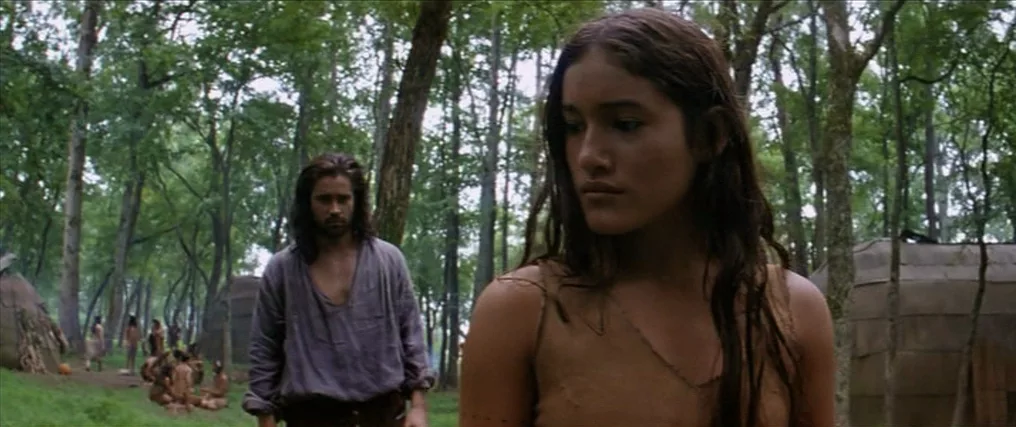
But it is the indulgence of Captain Newport was one thing; the compassion of Pocahontas, the beloved daughter of King Powhatan, is quite another. The gates she opens lead to a far more unsettling and inspiring experience for the taciturn and tough soldier – and she is transformed by what she has so generously but unwittingly unleashed. Dreaming of a true commonwealth, Captain Smith does discover a community of people whose values and habits differ profoundly from Europe, beguilingly suggesting another way of life is indeed possible, actually readily available. But he also discovers a more personal and emotional kind of harmony, uniting two people in love beyond all the cultural gaps that could lie between them – and the discovery is equally troubling and delightful for Pocahontas. Delicately couched in words softly read by the actors, their sparse but eloquent streams of consciousness fill the soundtrack while Steadicam shooting emphasizing closeups but also wider shots capturing nicely the waving and sauntering of the fit and agile bodies of the leads and others display a physical bond so ideal and perfect it seems to last forever – and the whole section does make up a huge part of the film that, as it unfolds, feels like an out-of-time experience shaped by a pacy editing collecting one precious moment of grace after another, the vivid representation of the prelapsarian world.
Things cannot last. Powhatan worries the bond is too close and that Pocahontas may be dangerously neglecting her duties to her people – some of whom think Smith should be killed. The Englishman is spared and brought back to the settlement which is now a ramshackle place where illness, hunger, and disorder reign even more efficiently that the self-proclaimed leader, Wingfield, who tries to arrest Smith. Wingfield is instead quickly killed and Smith chosen as the new leader – but winter comes and survival looks impossible, until Pocahontas arrives with men carrying food and other stuff, saving the English colony.
At last the film’s narrative decides to match again, more or less, the historical record, after straying too mawkishly away. It is bizarre to note the sorry fact about the director of “Days of Heaven” (1978) but what he has so far delivered, in terms of story of course, not of storytelling, his style remaining as distinctively poetic and awesome as ever, looks rather like the 1995 Walt Disney production “Pocahontas”, based on the same egregious error, or rather foolish flight of fancy. When the Virginian colonization started, Pocahontas was barely 11: hard to imagine a love story with the older Captain Smith – and of course the 1995 and 2005 portrayals of the princess as a young woman are thus utterly inexact. For all the care Terrence Malick took to reconstruct many details, including the language these Native Americans spoke, and an imagery clearly attuned to the pantheistic views of the Native Americans, it is still silly to watch him treading the same lazy romanticism that has been attached to Pocahontas and that the Disney studio exploited in its typical style.
The point is of course different – though the audience would be hard-pressed to figure out what kind of viewpoint that is not anchored in psychology but rather in politics or culture lies behind that Pocahontas. Her identity and role have been inevitably subject to getting mythologized and to be historical arguments but here she mainly stands out as a young woman confronted to a radically different manhood and way of feeling and being even as she vows allegiance to a mother who could be her relative as well as Earth as as divinity – and then compelled to navigate the new world that the fraught relations with the English create.
Caught in the chaos upsetting constantly the settlement, with the colons battling for leadership – after taking the position of Wingfield, Smith is dethroned by Argall before Newport comes back – and then to conquer the land – harrowing images of her native community getting burned to the ground long after she was kidnapped to force his father to make a deal – and then trapped in the growing success of the colony, this Pocahontas first hopes that the love she feels for Smith could be a help and stands as a compass but when he sails away, keen never to see her again as he thinks their relationship would remain doomed, she is forced to find way to carry on and adapt – which is what the colons expect from her. Meeting and then embracing John Rolfe would bring a more secure life – and even celebrity and fresh success in England proper – who could have guessed it, remarks Smith during their final encounter.
The film is thus the story of a sensitive soul losing one kind of agency to find slowly and confusingly another one, losing a bright position within a community to acquire a peculiar one within another society. The film faithfully, with the right degree of melodrama, records all the conflicting, at times harrowing, emotions Pocahontas feels during this inordinate narrative arc, and it ultimately emphasizes her resilience and the woman shot across the verdant though misty England at the end is nearly as confident and radiant as she came across first. “The New World” ends up being a most romantic tale delving deep into the consciousness of the implausible lovers, a quest relying on carefully written lines using simple words while expressing a really philosophical perception and fleeting images potently composed to convey first tenderness and then despair, great showcases for actors invited to reach for the most profound and intense sentiments they may hold – that anyone can hold in truth. Exploring a new world means here exploring the soul – civilizational encounter leads to an awakening to love and difference that would change the characters crucially.
This romanticism, underlined by the use as a poignant though somehow too self-evident motif of the second movement of the 23rd concerto for piano and orchestra of Wolfgang Amadeus Mozart, is graciously embodied by a two leads delivering solid and subtle performances, wonderfully expressive and earnest. It is also conveyed by the gorgeous imagery of Edenic and majestic nature Malick’s agile camera so elegantly captures, making the silver screen a vibrant texture and vivid palette.