
United States, 2025
Directed by Kelly Reichardt
With Josh O’Connor (James Blaine Mooney), Alana Haim (Terri Mooney), Jasper Thompson (Tommy Mooney), Sterling Thompson (Carl Mooney), Eli Gelb (Guy Hickey), Javion Allen (Ronnie Gibson), John Magaro (Fred), Gaby Hoffmann (Maude)
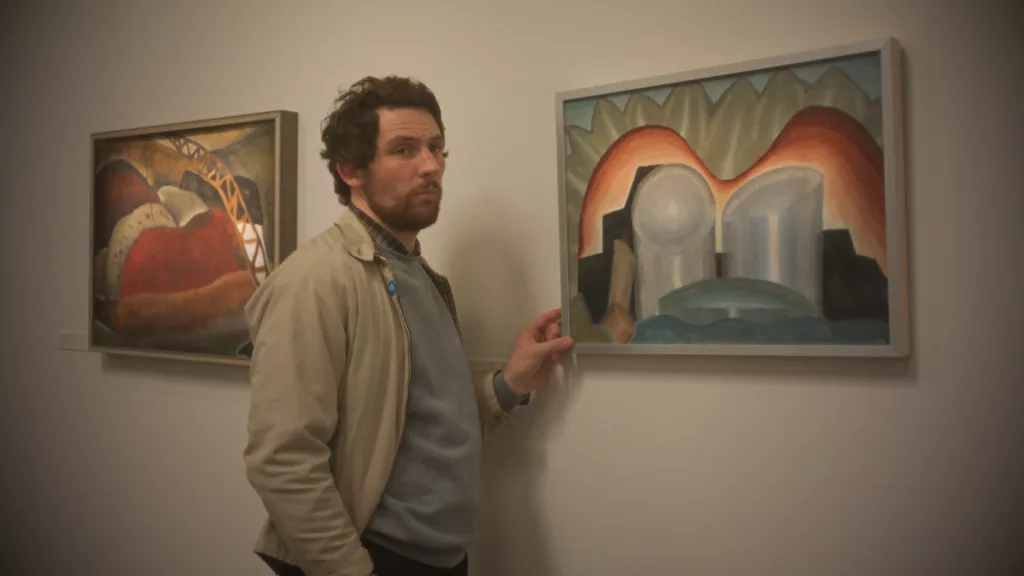
Months go by, clothes change, but he is still there, pacing the rooms of the local museum of art, observing carefully the paintings and the staff. It is plain the silent, serious fellow is scheming something, planning a big job and reckoning every detail.
What this mastermind plans to do is revealed as he spells out his big idea to two sidekicks in the basement of his suburban house. It is cast as easy, with little risks and inconveniences attached, even if it is about stealing four contemporary masterworks. But the Arthur Dove paintings are so poorly protected, with no alarm system and dozy guards (he demonstrated to himself how lacking was the safety measures by stealing quietly and smoothly a historical wooden figurine) that really no big hurdle is to be feared.
The guys sound rather doubtful, because they never thought of such a project and because they cannot figure out how it could bring money – how the paintings are going to be bargained is indeed a good question, especially in this small corner of Massachusetts in 1970. But the mastermind once again, with his smile working to inspire confidence and benevolence even if there is a trace of shyness and pretense on the corners of the lips and over the eager face, reassures them while skipping adroitly answering them.
But doubt can persist outside the frame: what the audience has been invited to watch between those two strings of typical scenes of a heist movie is the stilted intimacy of James Blaine Mooney and his family, wife Terri Mooney and sons Tommy Mooney and Carl Mooney, both at home and his parents’ far more lavish place – it appears later the grumpy father is a senior judge while the tense mother is involved in the running of the museum. It also transpires how diminished James Blaine Mooney stands in this circle, a nonchalant and ineffective male figure dealing with a wife who barely speaks and looks more embarrassed by her life than satisfied, behaving more on an autopilot mode than with any sense of feistiness and gusto, two kids who way too raucous and even look smarter than him, parents dismayed by the fact he does not know how to earn his life even at this arguably very advanced stage of his adulthood. James Blaine Mooney is a failed entrepreneur, and perhaps quite simply and bluntly a no-hoper, and taking on a criminal career may sound the easy option to keep his head above water, even though he definitely does not fit the stereotype.
Trouble, perhaps inevitably, is there would be more to this bizarre, funny, feeling he does not belong to a gangster story: there would be hard facts, twists and turns, that quickly shape up to make his flimsy, falsely facile, scheme a disaster. The fancy turns into a nightmare first because the sidekick tasked with driving the needed cars quit at the last minute, compelling a horrified James Blaine Mooney to give up on the safe hands-off position he carved up for himself even as on that fateful day he must look after his sons whose teacher is absent; then the guys tasked with the stealing, Guy Hickey and Ronnie Gibson, prove hilariously clumsy and struggle to get it done; then Ronnie Gibson, a young, bombastic, agitated, sloppy, addicted boy ends up nabbed for another robbery and spills the beans on the museum affair who is the talk of the town; and finally Guy Hickey gets in touch with real mobsters to make sure the paintings would be sold, putting his boss in a humiliating situation hastening his fall. The police, of course, show up, sparking a deep crisis in the couple, with Terri Mooney moving away with the kids (one after another, though, as Tommy is reluctant to part ways with a father losing his grip on just everything).
The film’s second part shoots the stunned and despondent failed gangster on the lam across Massachusetts. James Blaine Mooney reckons old college mate Fred could hide him away but runs into the determined opposition of jovial Fred’s sterner partner Maude – the night talk the straightforward Maude and a James Blaine Mooney in denial once again pretending he does not know what she is talking about and displaying this smile trying to charm and to convey confidence even as it looks a bit forced, giving some insight on what the flawed scheme was about, the links and the expected outcome. So James Blaine Mooney must keep running away even if he has less and less money. He tries to get in touch with another old mate in Cincinnati but to no avail. He keeps drifting and playing shady and sloppy tricks, until he is arrested just for taking part, while running away after robbing an old woman, in a demonstration against the Vietnam War.
Hard to imagine a more bitingly ironic, plainly absurd conclusion. Even if morals were to prevail, a different string of incidents could have been shot instead of this implausible and grotesque encounter with the batons of a riot police. But this matches well a narrative that has been pleasantly tinkering with the tropes of a genre only to cast a lead character and a big adventure running against the logic of the heist movie. There is little feeling awesome or desperate in James Blaine Mooney and a lot conveying bad luck but even more plain silliness and delusion. Yet he cannot be simply dismissed as a hopeless fool, like Ronnie Gibson: he is more, oddly, as a dreamer sleepwalking into a world he does not know how to fit in and truly does not care much to fit in – watch the wry comments he utters, still with his smile this time suggesting real fun with no pretense and with genuine wits, about the righteous statements of his prig and severe dad.
The film can look an equally nonchalant and off-centered genre exercise, delicately and bafflingly attuned more to the odd lead than to the sexy adventure, the thrilling scheme, the bold story he crafted to himself. It is not overly concerned with the suspense of such a plot – this is definitely not an heir to “Le cercle rouge” (1970). As often with a Kelly Reichardt movie, pace is slack, more a desultory walk trough the life the characters try to make sense of than a conventional, formatted, predictable, narrative development, bringing in this case the audience back to what life looked like half a century earlier, when there were no smartphones, no computers, no cable television, no Internet, no SUVs, no CCTVs. The attention to small gestures is key as always in her idiosyncratic cinema, while moods are quietly captured through the slow motion attitudes of characters trying to get by day in, day out. Her images have a hazy texture and autumnal hues vividly conveying what the era may have looked like, a great view of an America already bitterly politically divided, mired in wars, Cold and not so cold, remote and not so remote from the hearts and minds, and, though on less cruel terms than in the 2020s, unkind to anyone on the fringe, maverick, misfit, loser, dreamer.
Reichardt makes an alluring yet slightly detached portrait of a self-delusional guy getting overwhelmed by his flaws and failures but nevertheless clinging to his dignity and his pretended manliness and ingeniousness – mark how he pointedly rejects Fred’s suggestion that he goes to Canada and becomes part of a hippie community a common friend has set up. She gives actor Josh O’Connor an original role that he performs handsomely – actually, he is more convincing that many other cast members, starting with actress Alana Haim stuck with a weirdly muted, opaque, slim role, one among more notionally eccentric figures than fully-fledged and credible characters. But maybe it is because they cannot be perceived otherwise by a solipsistic lead so unable to grasp whatever happens and whoever stands beyond his scheme and survival.