
Germany, 2025
Directed by Mascha Schilinski
With Hanna Heckt (Alma), Greta Krämer (Lia), Filip Schnack (Fritz), Lea Drinda (Erika), Lena Urzendowsky (Angelika), Florian Geißelmann (Rainer), Laeni Geiseler (Lenka), Zoë Baier (Nelly), Ninel Geiger (Kaya)

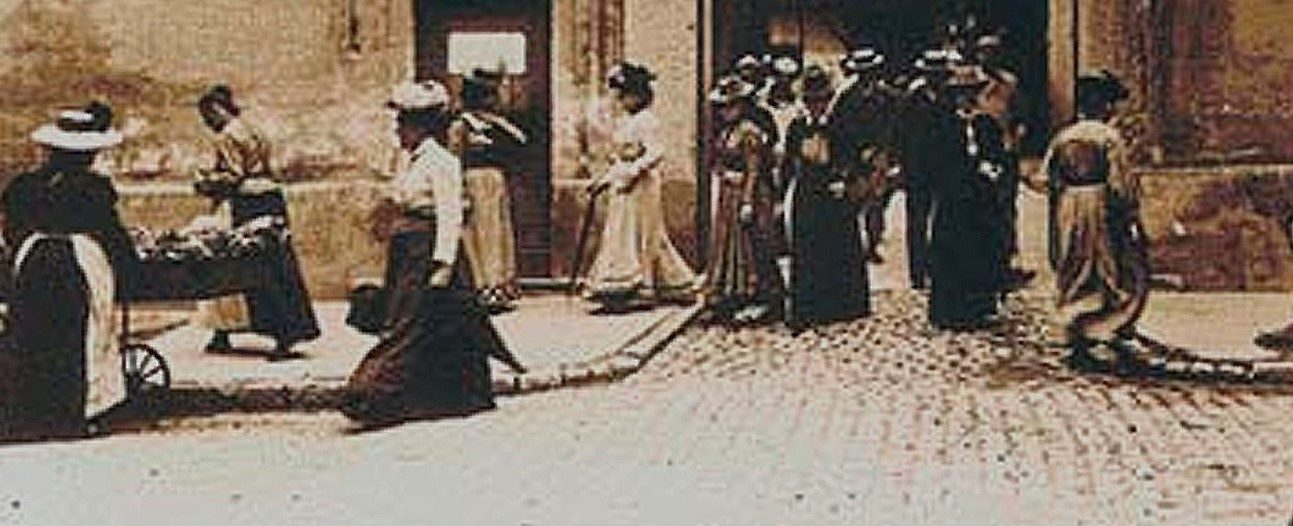
The strikingly grainy texture, which enhances the contrasts of colors and lights while lending a slightly eerie and distant appearance to characters, places, and objects, is more than a distinctive attention-grabbing feature, it is the form holding together the shattered and confused string of moments spanning many lives and many eras that make up the narrative. A refined work on the soundtrack built around the aural motif of a deep, strange, uncomfortable rumbling that could come from underwater or the underground, or perhaps another world, stands as an equally stunning and mesmerizing complement to images that can get blurred, faded, dissolving like fleeting memories, though parts of the meandering and sweeping narrative can look sharper as they come straight from the period when this sophomore feature was shot.
Slowly another bond holding together the various characters and eras of the German history under scrutiny emerges. Everything takes place inside the same rural property in an unspecified northeastern corner of the country, away from the mountains and the sun of the south – the skies show it – and once part of the communist-ruled East Germany. The farm is the constant stage of successive family dramas and routines, an inescapable locus that is a frame and a horizon, first owned by a peasant family over three generations and later, after having seemingly been abandoned, perhaps in the wake of the fall of the communist regime, occupied by the young couple living in the film’s present time and keen on transforming the main building which has fallen in disrepair: the place refuses to be deserted, the humans refuse to neglect it.
Unlike what other films did, including contemporaneous ones like “Affektsjonsverdi – Sentimental Value” (2025) by Joachim Trier or, even more precisely and brilliantly, “Sob a chama da candeia” (2024) by André Gil Mata, or what Virginia Woolf managed in “The Waves”, “In die sonne schauen – Sound of Falling” does not really make the farm a genuine independent character and does not explore it as a cinematic passage bearing witness of time passing and sentiments changing, despite intriguing shots early in the film capturing the mischievous games of kids or more poignant ones casting the barn as an inescapable trap luring people to their death. Even if things happen that trouble children and teenagers, the farm can hardly be viewed as truly mysterious, concealing its own kind of menaces and wonders behind its walls (and neither do the fields around and the wider nature represent a world enigmatically inviting to a life-altering experience). It is basically a set where people stumble into disaster or plod towards banality, a décor hosting a social order, rituals, projects the lead characters must confront, guess, manipulate, flee, whatever.
Those leads are the other peculiar strand tying the film tightly. All are either children or teenagers: many adults mill around them, shaping and swaying their lives, but nevertheless remain off center, with men looking even more aloof and inimical than woman. It is the youth who ground the scenes, through a simple but arresting gaze, with decisive if odd actions, and by speaking out, their voiceovers expressing their sentiments and illuminating their sensations. And there is a lot in each case to realize and to come to terms with incidents, encounters, and clashes shaking deep their consciences as they discover the intricacy and tragedy of the world around them partly underpinned by the forces of Eros and Thanatos.
The overarching note is terribly somber, bound to upset, reflecting existential distress. The first sequence displays the bizarre effort of a teenager to walk on crutches as it her left leg had been cut and then, once getting rid of the leather strap holding that left leg bent against the thigh and of the wooden crutches, her furtive visit to a man lying in his bed, probably naked, without a left leg, with a navel soaked in sweat standing as a magnet the girl oddly contemplates, temptation glistening her eyes, flushing her cheeks. Then the second sequence, misleadingly started with a prank three sisters play on a maid, moves to the day-long and night-long celebration of the dead on November 2, stifling austerity and religious zeal filling the frames to a most forbidding and daunting point. Dying or thinking to die, or just vanishing into thin air, becomes a motif, yet another element allowing the hectic and dreamy stream of vignettes to coalesce in the audience’s minds. The farm is not only the place where life blooms but also a tomb ready to open.
Innocent and playful Alma, with her wide-opened eyes and her instinctive curiosity, living at the time when the farm was thriving, under the late Second Reich, with World War I looming, is the character forced to witness the most harrowing events. She is the silent and puzzled observer realizing the deep unhappiness and helpless suffering of her relatives – from an elder brother, Fritz, the fellow who would fascinate later a female teenager, who has lost his left leg while escaping the wrath of his conservative and intransigent parents keen to punishing him by cutting his left hand off, to a dour and distraught mother suffering from an inconvenient hiccup, struggling to express sentiments and to feel satisfaction, and losing her ability to walk, the most tragic development Alma watches remaining the suicide of her elder sister Lia who refuses to leave her family to get married in another farmer’s family, the shocking end of a nice, delicate, intelligent character trapped by the needs and conventions of her milieu and her era.
Mirroring in part Alma’s experience, the sisters of the modern-day couple, Lenka and Nelly, increasingly lose the fun the experience of spending the summer in the old house their parents want to refurbish, slowly bowled over by a bitter dissatisfaction, the feeling that life does not deliver what it seemed to promise. The sudden friendship with the wild daughter of a neighbor, Kaya, seems to hasten a despondency the camera captured intently, observing sulkiness creeping irreversibly and terribly over their faces. But if Lenka only grows more angry, Nelly ends up repeating, without anyone driving her, the tragic leap Fritz took so many decades ago – and this time, it is not a limb that is lost, inside an accidental but explicable chain of events, but a full life, without any clear reason, in a scene whose mise en scène amazes and whose impact lingers.
The most elliptical plot concerns Erika, this relative of Fritz, his uncle, who is so obsessed with his body, his handicap, but also his virility. Clearly, more than a Lia, working on the farm does not turn her on to say the least – an impatient relative would slap her violently because she showed up very late, despite his shouts, to look after the pigs. She is an ethereal presence, vanishing on the other side of the nearby river among other women floundering to flee an invading army and never to reappear, neither in the film nor in the lives of the other members, living or to come, of her big family (it seems she tried to avoid getting arrested, manhandled, even raped by Soviet troops – and this is the only element pointing to the time of her life; that means that for once a broad approach of 20th century Germany on the silver screen does not linger on the Nazi regime, refusing to portray supporters or opponents of Adolf Hitler and to delve into the frustrating conditions of a nation at war with a whole world and against a whole population viewed as devilish).
On the opposite, Angelika is a vivid, forceful, contrarian presence spending another summer at her mother’s farm, the awkward, bumbling, bespectacled, plain woman in her forties appearing to be the surviving sister of Erika (and thus a niece of Fritz and Alma). Angelika observes a lot too, like the children of the film, but above all tries to find who she is, what she feels, what she needs even as her sexuality starts to be a central, defining element of her identity (like Erika). She is fully aware of both the lust of one of her uncles and of the burgeoning desire of a funny and gentle cousin, Rainer. But she is also drawn to darker feelings, proving as concerned by death as other characters of the film, even dreaming of suicide. A vital force wondering where to go and what to desire, Angelika, whose voiceover expresses the most profound and poetic views, eventually disappears, like Erika, running away from her relatives as they are posing for a group portrait taken with a Polaroid – the last image they would have of her, and so would the audience, is just a blur.
Blurring timelines, smashing narrative arcs, weaving a fabric purposefully displaying holes as well as patches of intense emotions and striking events, the film is a most personal, singular, disorienting proposition to investigate a national history and the place of women inside the historical and sociological discourses. It duly and splendidly reasserts the nature of cinema as a creative medium perfectly geared to capture time and emotions as evanescent elements bumping against life’s mortality. Yet the shots are a real thing on film and memories real experiences shaping the living mind: those images do not exit in vain, but are precious reminders of struggles to exist despite the constraints of a given milieu, a given period, and a given place now looking like a vessel where sentiments, tragedies, routines can flow incessantly, one generation after another, one family after another.
Granted, what those female teenagers and children find out is mostly bitterness and confusion. But what their views convey is a fascinating, anxious, impatient, deeply-felt take on the world that the film translates with a gracefully sophisticated and poetic way, replete with rhymes et echoes, running perhaps the risk of being too great a mannerism and yet hard to overlook and forget.