
United States, 1957
Directed by Stanley Kubrick
With Kirk Douglas (Colonel Dax), George Macready (General Paul Mireau), Adolphe Menjou (General George Broulard), Wayne Morris (Lieutenant Roget), Ralph Meeker (Corporal Philippe Paris), Joe Turkel (Private Pierre Arnaud), Timothy Carey (Private Maurice Ferol)
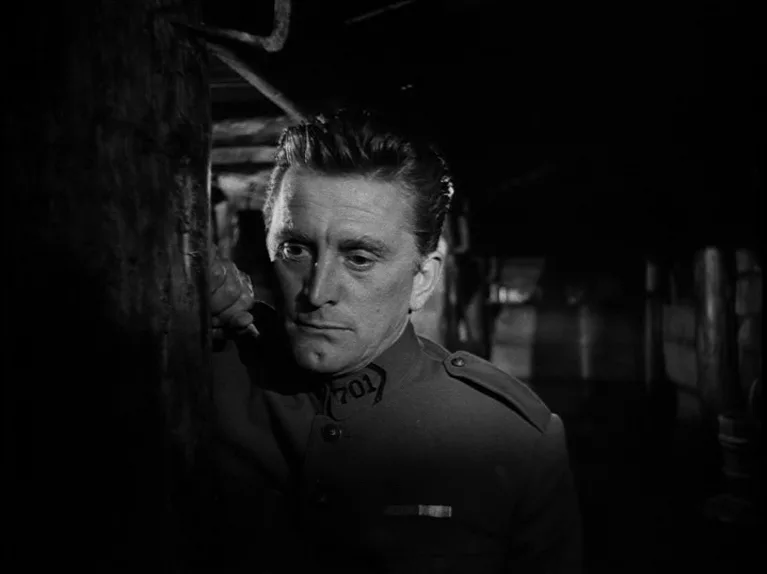
What can upset the most at the end of the day in this visually powerful and morally scathing glimpse on the way the French military waged the First World War is perhaps the final sequence, cleverly framed by shots of lead character Colonel Dax out in the street, first a grim figure surprised by the ruckus he hears at an inn, as he is likely still reflecting on the acrimonious talk he had with General George Broulard and also grappling with the news the troops he heads must swiftly pack up to go to a dangerous front line, and then expressing a fleetingly warmer feeling, tinged with emotion and hope.
A carefully edited suite of skillfully composed shots favoring unforgiving closeups and medium shots which belatedly shift from one mood to another, this sequence first comes across as unpalatable as many previous others, cold and disheartening images of men at war showing off the meaner, uglier side of a manliness that has been tailored to exert cruelty for the sake of survival – theirs and of their homeland – with hatred and lust the greatest spurs. They shout and behave unseemly with annoying gusto as the innkeeper promises on a makeshift stage a thrilling show courtesy of the enemy, an enemy captured and posing little threat while rousing desire: a young German woman, made prisoner and forced to stay and to work at the inn.
The scared blonde is invited by her leering and sordid boss to sing to please the loutish audience of soldiers looking like a pack of wolves. She has not other choice than beginning a tune, her words struggling to get through the ruckus. But the German folk song that has sprung to her panicked mind does get louder and louder and slowly quietens the audience. Actually, the men soon feel under a spell, cradled into a sympathy and an affection slowly creeping over their faces still framed the same way but now bearing witness to a sentiment getting so overwhelming than the men start to hum the girl’s tune. No animosity but amity: a threatened but valiant innocence and the lilting notes of an old tune push aside the logic of confrontation and violence along state and ethnic lines, something deeply human crosses the line so fiercely defended, the futility of war feels self-evident.
The calculations of power cannot stifle simple, sincere, pressing sentiments and convictions, reactions and viewpoints. They should not even have allowed to cause havoc and to pervert and corrode humanity. Surely war can be avoided and authorities can be checked, cannot they?
Coming at the end of the precise scrutiny of a gross miscarriage of justice underpinned by personal vanity and social arrogance this sequence and such an underlying message about a shared humanity may have irked deeply the censors who in parts of Europe, starting with France, obviously and famously, have done their best to keep this technically awesome American production off the eyes of their fellow citizens. But it is not just an idealistic antiwar view and a statement of faith about humanity – which is arguably not enough of a good reason to ban and to trash – but also an emotional and resonating emphasis on two key points of the straightforward narrative.
The soldiers Colonel Dax has observed, has led, has also defended in a trial, deserve far more respect than what they can ever hope from their cadres and a wider system thriving on hoarding power and viewing those who do not rule as expendables and those who could rule but refuse as pathetic nuisances – that is why the last encounter between Colonel Dax and General George Broulard ends up being so bitter and toxic. And there is definitely something rotten and sinister to watch men in charge jockeying for power and making grand plans to please and appease politicians and journalists who are mired in the fog of a disaster they have been all too eager to unleash, willfully ignoring consequences and stubbornly carrying on even when failures are many and the whole business gets senseless. They are no heroes but epitomes of futility.
Stylistically, this final sequence fits, in a final flourish made with consummate talent, a smart pattern where the audience is lured into sharing specific views and feelings till an element, a line, an apparition, an action, swiftly makes the sequence and the way it is handled, including the ways a camera moves or stands, pivoting into another perspective and another mood. The principle is set up in the first sequence, when in the lavish castle where he is billeted a distinguished General Paul Mireau effusively welcomes a suave General George Broulard. The latter has come to convince the former to plan a big assault on a German position usually viewed an impregnable. Shot with high angles and eye level ones, the talk shows first how Mireau tends to reject the plan, vowing to keep his troops safe and unwilling to carry out a suicidal attack and to prevent an unnecessary slaughter. But then General George Broulard paces the stately and huge room evoking other plans: a change in commandment and a possible promotion. Standing at a distance – the use of the depth of field is clever – the two generals eventually find common interest. The camera can move closer to capture the contentment of the visitor and the glee of a host who has reneged on his views.
Better sacrificing his own men than losing a career opportunity: the vain General Paul Mireau is then shot visiting trenches, keen on passing on his orders. The camera follows him while tracking out: he saunters forward through the men and the mud, advancing ceaselessly towards the audience while the camera keeps moving backwards, still embracing a wide view of the hell where his troops are trapped. Then motion stops as he starts to talk with a sentry. The talk is a disaster: the soldier is dumb to a fault, still shell-shocked from a previous skirmish, and eventually collapses. This enrages the general, who orders the unfortunate private to be punished and proclaims that cowardice cannot be tolerated – as if it was really the problem.
He starts to walk again, but now the camera has pivoted behind him: it is no longer his determined, haughty face the audience is faced with but just his back as the bleak landscape of trenches filled with exhausted troops still unfolds under our eyes. The man can no longer be an object of pride to be watched and acknowledged, though not to be liked; he is now a decidedly a ruthless psychotic. The talk he has with Colonel Dax inside the colonel’s shelter stands inevitably as a bitter confrontation between a leader turning maniacal and a subordinate who has not forgotten what is possible and what is not, a fraught talk brilliantly shot through the interplay of dim lights and deep shadows and relying on the contrast between poised attitudes telling much about he differing temperaments and foretelling the clashes to come.
The assault is a disaster. On the battleground, Colonel Dax realizes the extent of the problem. At a distance, General Paul Mireau cannot accept the face and puts everything down to cowardice, even instructing his artillery to shoot on a group of fellow French soldiers to punish them from not moving forward, that is, in the mind of the general, from not following his plan. The order is not carried out – and it would come back later to haunt the general and put him in a quandary. But his fall, this deserved comeuppance matching so well a happy ending and a deep sense of fairness, still occurs way too late for the soldiers who were made the fall guys that he and his superiors needed to keep critics quiet, shifting the blame to that convenient crime of cowardice from their own distressing ability to misjudge a situation and craft faulty plans.
This is the core of the narrative: the search for scapegoats, the few bad apples that have supposedly rotten the entire battalion, making the troops losing their guts at the key moment, and that now need to be eliminated. How many bad apples and what kind is a matter first of cynical haggling between the generals and the colonel. To be court-martialed three men are eventually picked by chance: Corporal Philippe Paris, Private Pierre Arnaud, and Private Maurice Feral – actually, everything suggests that the corporal was deliberately chosen by his commanding officer, Lieutenant Roget, out of vengeance (at first looking like a sideshow highlighting how dicey and ugly the war is, the episode leading to the clash between the two men not only find a belated but adroit way to fit in the grand tale but also looks in retrospect as a herald of the wider crime the film denounces, the real cowardice rarely coming from the unlucky but dutiful soldiers but from officers who are unable and unwilling to take responsibility and even to lead properly the combat).
The three men are defended by Colonel Dax himself, who before the war was a successful lawyer and who now cannot staunch what his superiors have decided. The trial is cleverly exposed by the camera angles and motions as the mere theatrics it actually is, a deliberate travesty of justice set up to deflect blame. The plea Colonel Dax makes resonates as the scathing denunciation of the process designed to kill innocents – but if the moral point is made, the fate of the three soldiers remain doomed. The film proceeds to examine their last days before the execution by a firing squad, another fine set of dramatic and dynamic black and white cinematography conveying the increasing despair gnawing the sentenced soldiers, an unflinching reminder of what is means to be on a death row when waiting for the executioner gets excruciating, when the wait and the fear sound like an execution even before a bullet is fired. A chaplain provides only so much relief: despair carries the day inevitably.
The execution takes place in a court outside a palace leading to graceful gardens. The depth of field and the naturally existing perspective and symmetry of the locus are fully exploited by the camera and this is precisely these striking visual elegance and rigor that lend to the action such a harrowing and horrifying quality: the execution does look like what it is, a monstrosity and an injustice. This is the real climax of this tale shaped into the mud of the trenches – and the astonishing reconstruction of the battlegrounds “Paths of Glory” offers deserves much praise – and the vanity fair played by generals and hosted in great mansions: the ceremonial killing for the sake of an institution’s power adding three more dead to a massive slaughter, three more dead still feeling like three too much, more blood that can be tolerated as these demises are even more futile and unfair than the countless others that have occurred.
This can also explain why the final German folk song sounds so precious: an unexpected testament of the beauty of peace and life that should matter far more important than any power, than the vain glory of commanding, than the inept prosecution of war.