
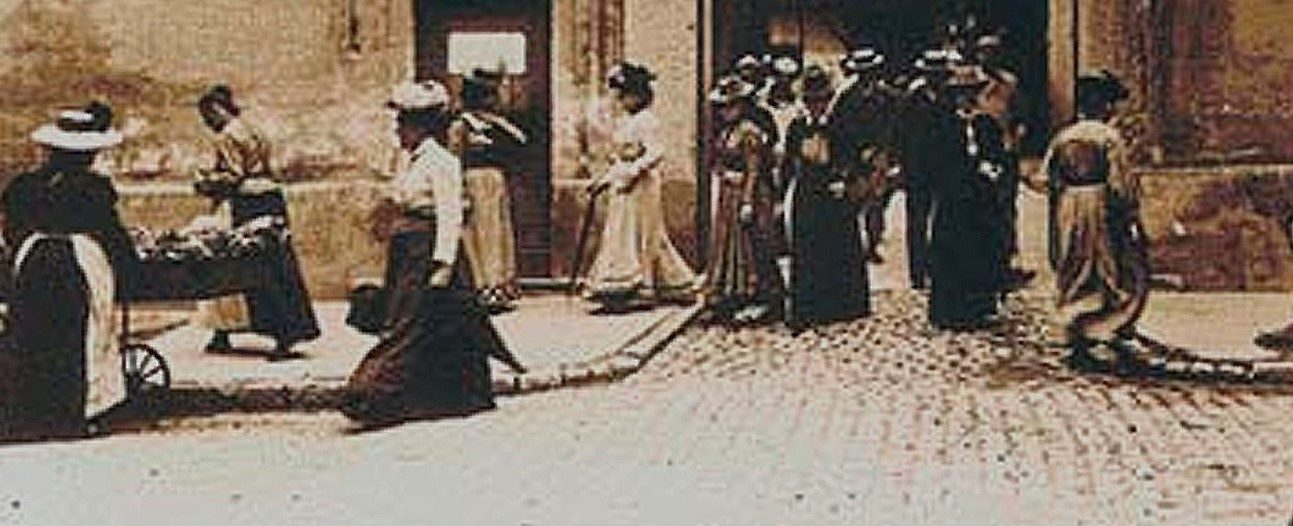
United States, 2019
Directed by Kelly Reichardt
With John Magaro (Cookie Figowitz), Orion Lee (King-Lu), Toby Jones (the chief factor)
While his host, King-Lu, toils outside, splitting wide, hard logs to light a fire, the guest, Cookie Figowitz, takes a few steps around, gingerly and limited by the small dimensions of the cabin, feeling embarrassed and useless, and then picks up a broom and starts sweeping dead leaves and dirt off the rough floor. At one point, in the old 1.375:1 frame, Cookie is shot on the left, close to the foreground, framed by the open door, while King-Lu is visible, both by Cookie and the audience, in the background through the frame of the open window, close to the door and more at the right of the composition.
Handling a broom: things can start as simply, quietly, ordinary as that. By cleaning up the place of the fellow traveler he once helped Cookie takes the first step to accommodate himself and the shot showing both guys so busy with domestic chores signals a bond is not just stricken, it has been before, but is rebuilt to last, at least as long as they could get on and enjoy the pursuit of happiness the young nation where they have been wandering idealistically promises. The shot is the real beginning of a friendship, the key moment of this buddy movie which is also a period piece dealing with a part of the occupation of the American West that may not have featured heavily in films and books, the slow influx of people in what is now the Oregon State, a few decades after the coast was reached by explorer James Cook, a region the young United States acquired from the imperial United Kingdom by treaty only in 1846.
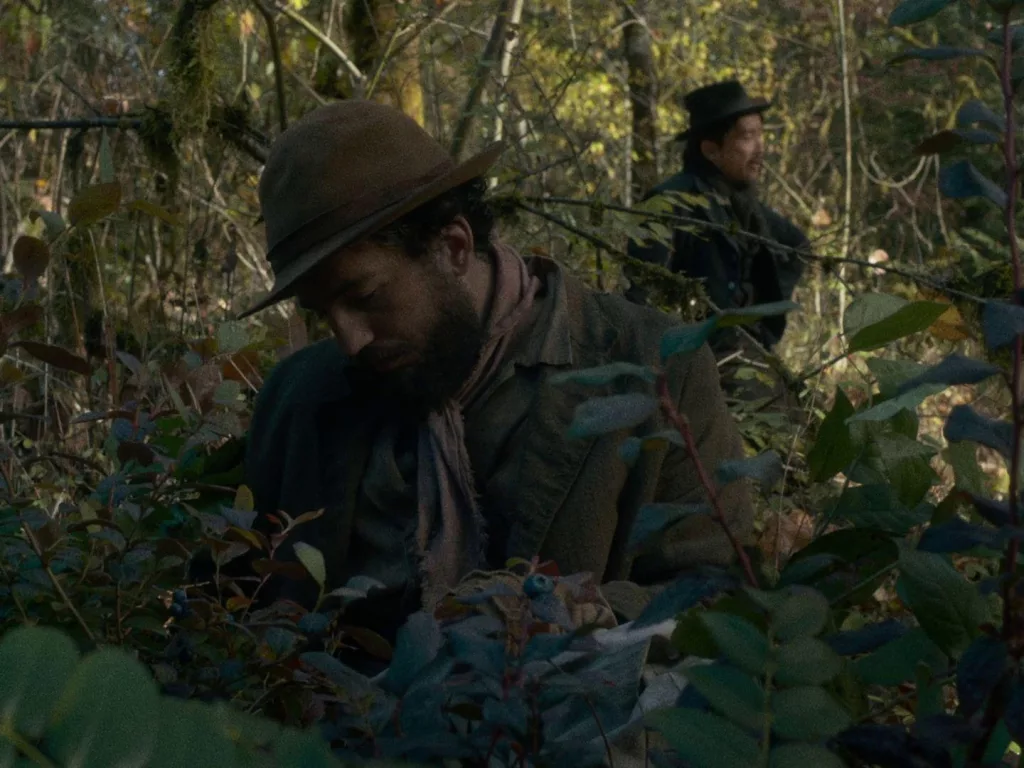
A view from a frame: it was not made from planks or logs but from ferns and shrubs when Cookie first met King-Lu, then a hungry, lonely man in the buff running away from Russian trappers. Cookie was looking by night for food for the American party of trappers that hired him as a cook when he realized a human face was looking at him through the frame made up by the lush vegetation of the region. Noticing, watching things through a frame, usually a window, is a distinctive feature of Cookie, who is more broadly pictured as a keen observer, avid too, as evidenced by the way, in the first shots of the character, he searches for food on the ground, or reckons what a Native American girl is doing with a pail in a fort. What he sees through these frames are elements heralding for change, bringing satisfaction, or relief, although they are are not going to be as felicitous as the seminal first one, for instance, when he is finishing cooking a cake, when he comes round after his fall in a slope, finding out he was rescued and nursed by an old Native American couple, or when he looks for his pal in their cabin that has been ravaged by the angry party pursuing them.
The camera then takes readily his point of view, following his gaze or looking through the frames: it is in a way his story, telling how a diffident, quiet, and orphaned fellow from Maryland is trying to make his way in the West and get a living, an arduous task, a real challenge for his temperament. He is man of few words, and not particularly practical, ingenious, or brave – although he is a fine cook, clearly a first-rate baker – and an easy prey for troubles and hatred, as the very testy relations he has with the American trappers show. By nature and by experience, he is forced to be cautious, on the watch, to stand a little back from the wider life, still expecting something good, someone good would appear on the horizon.
That someone good turns out to be King-Lu, a native of China who has traveled the world before landing in the New World. He may be as unlucky, poor, despised as Cookie, but he is otherwise far more different: outgoing, optimistic, reckless, and remarkably resourceful – when they meet back at the fort where Cookie has arrived, and observed so much, he is living in that cabin he built himself so skillfully, while Cookie lives in a tent. Because he cannot forget how Cookie saved his life and he probably enjoys a company listening to him and liking him, he right away accepts to welcome Cookie. This is the start of a strong friendship, a deep bond between two guys trying their luck in a hostile environment.
That something good gives the film its title: it is the first cow to be brought to that distant corner of the Pacific Northwest, alone as the beef that was with her did not survive the sea journey, the pride possession of the chief factor who wields the real power in the fort, dealing with trappers, merchants, and local Native Americans. The plot is simple: cow means milk, and milk means cookies – what a cook likes to do and what someone with business acumen likes to sell. So King-Lu convinces Cookie to take the cow’s milk, in the secret of the night, and to bake as many cookies as he can, so both chaps can raise enough money to clear out and invest in San Francisco. The honest, wary cook is not enthusiastic, but doing what he has got a gift for sweeps doubts away. The brash, excited adventurer gets carried over by the success of the cookies, and insists on keeping milking the cow every night and on raising their output and ambition, even accepting an order from the chief factor, though there is the awkward possibility the chief factor, or in fact anyone, starts to wonder how the cookies were made, and comes to realize that something fishy is going on with the cow.
One night, as it could have been predicted, things go wrong. Cookie and King-Lu are chased away, get separated, then reunite, but Cookie is too weak and their heads are wanted. Tragedy is inevitable. The glad pursuit of wealth turns out to be a lethal danger, definitely for those who scrape a living at the bottom of the fort’s society and economy, while those at the top can cheerfully speculate on fashion in Paris.
It is a harrowing end to what has been a simple, quiet, ordinary friendship, shot matter-of-factly, shots of casual chats, moments of shared tranquility, actions performed seamlessly in perfect harmony, the routine of all these elements day in, day out, as the film takes a slow pace, as unhurried as life could have been in such a place, at such a time, in such a manner. A key point, even the forte, of the film and director Kelly Reichardt’s art, by the way, is the emphasis on gestures, the readiness of the camera to focus on feet (those of Cookie are the first human element to appear on-screen), hands, the way a tool is used, a cloth is worn: what it physically took to toil and survive in the West is plainly highlighted, with the careful observation of the dirt around the men, the roughness of the fabrics and instruments, the wear of things, or their blatant lack.
The dull world of the pioneers stands in a stark, stunning contrast with the beauty and majesty of nature that is revered by the cinematography and a gorgeous palette of greens and browns (and how dull and rough being pioneers of the West has already been examined by Reichardt in her 2010 women’s tale cum western drama “Meek’s Cutoff”). It is this quiet effort for authenticity, the attention to mundane details, the sympathetic, engrossing observation of the lead characters, the peculiar rhythm of the whole business that allow those characters to feel so compelling, vivid, close to the audience, striking a chord, standing as a reminder of how hard it was to settle in the West, how a moving but taxing experience it should have been for countless folks.