
Japan, 1973
Directed by Yamamoto Eiichi
(Animated movie)
Based on a text by Jules Michelet, better known as a historian than a novelist, the film tells the story of a young peasant, Jeanne, who is blessed with the precious but fatal gift of beauty, and is in love with another young peasant, Jean, who adores her. They vow to get married but since this is the Middle Ages France, not only they must go to the church but the ceremony is to be attended by the lord owning the land of the village they come from and his court. Moreover, it turns out they must pay him a tax, which is exorbitant.
Jean protests and beseeches a favor. His vicious lord’s reaction is cruel: he right away exercises the “Right of the First Night” and Jeanne is raped. Humble and traumatized, she becomes depressed. But a strange creature shows up at the couple’s house, set on making her happy again and to grant her wishes. The funny tiny figure is of course the Prince of Darkness and Jeanne fully realizes it. But the temptation is too great, as well as the fun the creature provides prodigally.
Overnight, the fabric she weaves become a popular commodity and the sudden wealth the couple earns draws the benevolent attention of their feudal lord who picks Jean as his taxman. But when Jean fails to collect enough revenues for the war the lord has decided to wage, he is savagely punished, with his left hand hacked, and the couple is sent back into poverty and misery. Jean drifts and becomes a drunkard while the spouse of the lord torments Jeanne. The cursed young woman reluctantly accepts to make the damned Faustian bargain with the Prince of Darkness. Shamelessly thirsting now for power and sweet retribution, Jeanne gradually transforms into an omnipotent and destructive vessel of seduction as her newly-acquired powers go hand-in-hand with the blackest of witchcraft.
The film shifts into a frantic and astounding chronicle of vice and depravity the fellow villagers of Jeanne embraced while the lord and his court are first gobsmacked and then incensed. The battle of will between the brutal lord and his wife on the one hand and the brazen witch, whose master stays at a distance and whose husband is out of touch, gets fiercer. Running out of patience with a contemptuous and determined Jeanne, the lord eventually arrests her and condemns her to be crucified and burned alive. The devil does not meddle in the wicked game of retribution Jeanne has eventually lost the bitter way but Jean attempts a last-minute rescue to no avail, getting speared to death in his effort. Jeanne dies and the social order which has made her suffer so much and is so egregiously unfair and violent keep thriving.
But maybe not for ever: the execution of Jeanne is not where the film ends, the editing then presenting old illustrations probably made in the 19th century invoking, in sync with the text now rolling over, the July 1789 revolution that gripped France and brought progressively down the Ancient Regime social and political order, drawn images conveniently putting front and center women as players and even leaders of the riot. Then the final shot shows, purposefully reframed to focus the attention on the titular heroine’s face, the famous painting Eugène Delacroix made in the wake of the uprising of 1830 ousting King Charles X, “La Liberté guidance le people”, “Liberty guiding the people”. The tragic fable is given a more political meaning, with witchery cast as a bold precursor of revolution and Jeanne as a heartbreaking and groundbreaking figure of legitimate revolt. To director Yamamoto Eiichi and his gifted team, her story can mean more than a stunning feminine riff on Faustian pact and medieval drama.
This bold epilogue associating witchery to a rebellion against patriarchal and feudal domination rather tells a lot about the zeitgeist dominating the developed world, Japan included, when this gorgeous animated movie was shot. Counterculture (opposing old-fashioned, mainstreamed, conservative attitudes) was all the rage as well as the urge to make revolution and exercise boundless freedoms, including in the sexual field. Feminist ideas were taking center stage, nearly as much as leftist ideals, and soon to be followed by queer quest for recognition and rights. Actually, feminine identity is in itself a revolution: in the case of Jeanne, her beguiling and riveting beauty immediately stands as a gauntlet thrown to a bleak world dominated by the ugly and the destructive: the face of her lord is a barely arranged skull, his wife has sharp and daunting features, their courtiers look like caricatures; later villagers would often appear as an entangled dark mass of barely sketched figures and then as just plain people drawn in simple lines soon morphing into whitish friezes whirling under the pressure of a raw sexual urge. Jeanne’s outstanding and wonderful is soon to be a curse but then she would harness it to become a potent force ready to upset the social order.
The limit is of course she does not act alone: her fight is also a fresh assault of Satan against the creation of God, however perverted it has turned at the hands of human thirst for money and power. This is not evil that prodded the crowds to barge into the Bastille or to battle with royal troops: but then, in the medieval times the film shows, which were deeply shaped by faith and churches, the struggle between good and evil could have been the most obvious interpretation available to explain inordinate behaviors – unless it was tweaked or ignored by an individual to keep their distance to mainstream beliefs and attitudes.
The film strikes because it conspicuously refers to another aspect of the 1960s free-loving culture the feminists might have not embraced so keenly, or perhaps with another worldview, an aspect that is arguably the most decisive force driving the narrative and the narration: it is eroticism, which is unashamedly displayed even when it is the most disturbing and cheerfully used as a provocation. Nakedness is exposed as soon as Jeanne’s rape begins and would remain a fixture, even extending to the whole population of the village in an astonishing orgy highlighting the power Jeanne wields as a witch and the chaos she could unleash on the staid order decreed by the lord. A pounding, angular, mass would represent the vicious lust of the lord, ribbons of frieze-like characters, on the other hand, would chronicle the thrill of the orgy that may leave some villagers confused and embarrassed but nevertheless was a dizzying taste of freedom and pleasure their tedious lives stuck to the thankless earth under a feudal yoke probably do not enjoy much.
The devil itself first appears, quite provocatively, as a little creature looking like a penis. And as he wriggles inside the dress of a suspicious Jeanne, it is clear that sex, as much as promises of power and wealth, and later of retribution and revolution, is Satan’s best weapon to control Jeanne and make her his servant. Then again, the narrative is ambiguous: it could be fine to celebrate sex as part of a wider rebellion against an unfair and crushing power, to affirm one’s own sexual pleasure as an element of identity and liberty that cannot be compromised or manipulated. But in Jeanne’s case, it remains tethered to a darker, dicier, force while the bonds of love and tenderness Jean has represented have become tragically irrelevant. It seems grand ideas as liberty or dignity and basic needs as survival or agency cannot spring from a pure source and pertain to a comfortable, clear-cut set of alternatives self-evident to grasp and to pick.
The counterculture and the visual culture of the 1970s can be readily associated to a fashionable adjective, psychedelic, which means imitating, being suggestive of, or reproducing effects (such as distorted or bizarre images or sounds) resembling those produced by those new drugs producing abnormal psychic effects gaining then in popularity. The explosion of bright colors and frantic lines the film delivers conjures up the word inevitably. But the style is even more excitingly boundless and explosive.
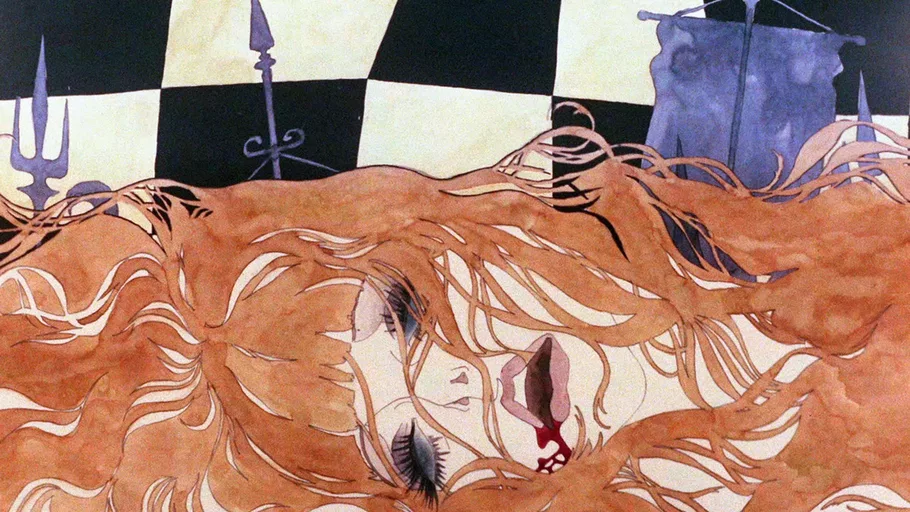
Animation is not constant: still images are as frequent, kind of delicate portraits or stunning tableaux over which the camera moves, gliding in various sense, including from bottom to even higher tops – this is the way the wedding of Jeanne and Jean is captured. The film does not look so much as an ordinary, speedy, anime than the old practice of unfolding a scroll to discover inches after inches a whole picture – just like a traditional Chinese painting. Characters’ actions and reaction create only part of the sensation of motion: more comes from a camera-induced effort to contemplate and to absorb an elaborate vision of a tragedy boxing innocence – and the face of Jeanne can be a reminder of many graceful paintings of great secular beauties or more religious ideals as well as the sinuous creations of the Art Nouveau – into the rigid orders of malevolent powers, be it the frozen and massive shapes of the court or a towering Satan amid peaks.
And this vision plays with textures, even inside a single frame: the lines have various degrees of thickness and refinement, the colors can be bright or more like pastels, they can also be dense spots or wide splash of watercolor. The psychedelic here is rather the exalted and inspiring attempt to convey the many aspects of Jeanne’s unnerving story and fragmented world and her own perceptions. This may be the ultimate and most rewarding liberty “Kanashimi no Beradonna – Belladonna of Sadness” has in store: letting her tragedy becomes a force shaping, twisting, energizing the tools of animation, harnessing eroticism and rebellion to investigate what agency a woman can claim between the appeal of her beauty and the curse it also is.