
(West) Germany, 1972
Directed by Werner Herzog
With Klaus Kinski (Don Lope de Aguirre), Del Negro (Father Gaspar de Carvajal), Peter Berling (Don Fernando de Guzman), Ruy Guerra (Don Pedro de Ursua)
A group of Spanish troops is sent to an unknown and tough area near the Amazon to find the place the Incas call El Dorado. The leader, famous conquistador Fernando Pizarro, quickly realizes the expedition is reaching an impasse and vows to move back, but, out of respect for his orders, decides to send up the river a party of 40 to fetch food and get information on the mythical place. Don Pedro de Ursua is chosen as commandant and Don Lope de Aguirre as second in command; both would be accompanied by ladies, respectively a wife and a daughter. Their rafts leave on the first day of 1561; it must return after a week.
The aspect ratio is just 1,37:1 – this is not a wide frame, more suitable to portraits than to depictions of wide spaces. The camera is hand-held most of the time, tracking the characters as they haltingly proceed on land and turning around them as they are trapped on their rafts. Some shots freeze on a character or a group as if the camera was ready to take a portrait (medium close shots and close ups are often used) while others keenly focus on details displaying the concrete difficulties of these Europeans soldiers to get by in tropical forests and rivers.
Although the running time is just 93 minutes, the film feels longer as it picks up after a hectic first part a slow pace, as tedious as the endless sailing and walking the conquistadores made. Rehearsals were not numerous and the images show the instant reactions and ad-libs of the cast as they dealt with the events. These elements add up to a well-thought and coherent technique, yielding not so much a panoramic view than an intimate vision. It is an up-close, truthful, and compelling portrait of a few people as they slide into hell, and this process makes the audience feel fully and disturbingly involved.
The expedition quickly becomes a disaster. First a few men are lost to a river swirl that drifts them away before Indians kill them; then the rest of the group is stuck in the jungle, deprived of food and direction; and finally Don Pedro de Ursula is challenged and made prisoner by Don Lope de Aguirre. The mutiny is justified by the need to pursue the El Dorado quest and the correlative refusal to obey the orders.
This is surprising as the first pictures of Aguirre suggest he considers the enterprise a folly. But then his lack of zeal to help the raft that got lost and to retrieve the dead (indeed, he would rather destroy the wreck) hints at an uncomfortable development. The mutiny is his own creation but he remains cautious enough not to take the leadership, getting instead Don Fernando de Guzman elected. As their new raft sails down the river, Aguirre would grow more authoritarian, forcing his small crew to drift further along the hostile banks in the ever more distant hope to reach El Dorado till they couldn’t even tell hallucinations from realities.
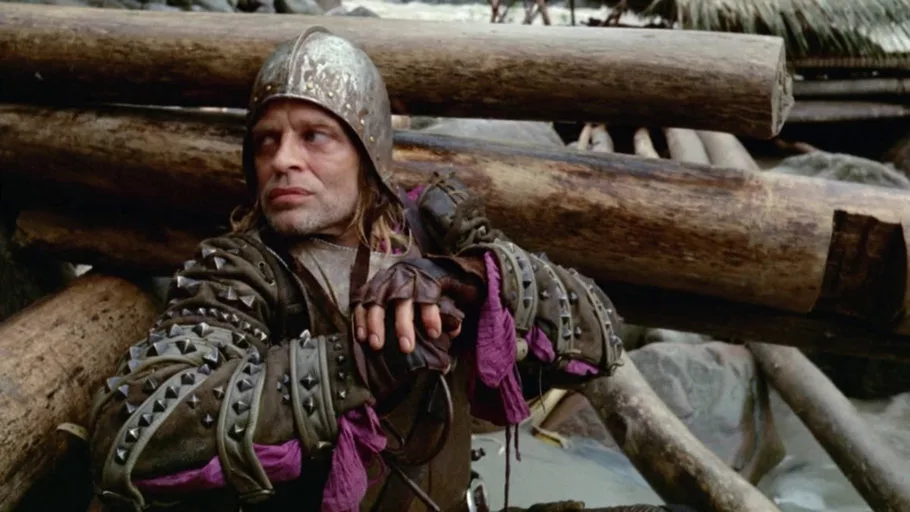
His piercing blue eyes popping out of a gaunt face, rarely clean-shaven and always topped by a heavy helmet, Aguirre looks like a creepy creature and does behave like a beast, half-crippled, with a rigid leg and a limping arm, the kind of creature you grudgingly keep observing – and actor Klaus Kinski delivers the most arresting and awesome perfromance, a splendid but borderline show. His influence on some men is chillingly powerful and his cruel and brutal bent holds the rest of the group in awe, with the exception of Don Pedro and his wife.
His fall into insanity becomes obvious when he presents himself as the wrath of God, able to stop life if he wishes to. Aguirre’s unswerving rush forward safely delivers that dreadful result, as the final, breathtaking pictures show him ranting and pacing the raft, scheming grandiose political projects even as everybody onboard, including his beloved daughter, are by now dead – wild monkeys are his only audience. No clear explanation is given but, beyond any physical and personal frustration, the narration suggests that his folly can be put down to an unfulfilled ambition, a quest for power under the guise of the El Dorado conquest.
The story pretends to be based on the writings of Father Gaspar de Carvajal, a priest detailed to the wider expedition and then the small detachment so as to preach the Word to the heathen. His descriptions seem honest but his behavior gets questionable; indeed, he lets himself be carried away by the growing madness of Aguirre, accepting the mutiny, condemning Don Pedro de Ursula as he takes part in a kangaroo court, killing an Indian he doesn’t know how to convert or plotting against Don Fernando. When he eventually rises against Aguirre’s authority it is too late and he is too weak. The character is a disgrace and a mirror of the crew as they increasingly lose their common sense in their quest for gold. Their fate embodies the smug, selfish and sordid sentiments that drove the Spanish Conquest; the cruelties inflicted on a new land and its peoples are reflected by this terrifying tale of insanity that the tight frame and other specifics of the film’s style have so terribly enhanced, giving up the expected sweeping imagery of adventure in order precisely to grasp more immediately with the darkest face of the adventurers.