

United States, 1999
Directed by Paul Thomas Anderson
With Jason Robards (Earl Partridge), Julianne Moore (Linda Partridge), Tom Cruise (Frank T. J. Mackey), Philip Seymour Hoffman (Phil Parma), Jeremy Blackman (Stanley Spector), Michael Bowen (Rick Spector), Philip Baker Hall (Jimmy Gator), Melinda Dillon (Rose Gator), Melora Walters (Claudia Wilson Gator), John C. Reilly (Jim Kurring), William H. Macy (“Quiz Kid” Donnie Smith)
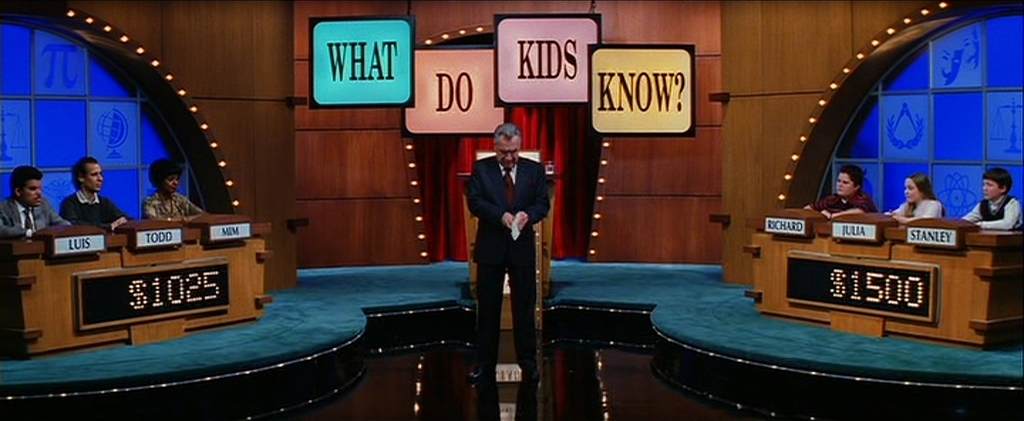
Over the course of a single day, the troubled lives of a few people living in California run in parallel before colliding through coincidence as well as buried pain, in what is a dazzlingly and sprawling operatic film. But it is really titled “Magnolia”: this is not “Short Cuts”, the opus magnus director Robert Altman made in 1992. A far younger filmmaker dares to revisit the signature kind of polyphonic, or choral, film that put Altman on the cinematic map since “Nashville” in 1976 to hone his own skills and style while offering a worldview that is arguably more plainly and effectively underpinned by compassion and quirky sense of humor and storytelling, away from the far messier, grumpier, graver, wittier too, look at America the old master had.
With zest and wit Paul Thomas Anderson displays swiftly his own credentials as a conspicuous wunderkind and a clever storyteller: his film starts with a narrator juggling three short tales spanned over many decades and shot in different ways, with one of them, the very first in fact, a keen as well as spoofy tribute to the silent era. Nonsense emerges as the fertile ground of a worldview betting claiming chance is the real factor behind much of the quirks and mishaps of our daily lives only, of course, to doubt this tenet.
Most of the characters of the wider narrative turn out to have connections, some very close but tough, and indeed tough because that close, with the glue, this being America, provided by mass entertainment, the kind thriving in the film’s California – which happens to be the real native place of the director. The show at the center of most of those fictional lives is the kind of television quiz celebrating high culture. In this case, the show has grown so popular it has become the longest quiz show ever running on television and its presenter a household name, a paternal and beloved figure celebrated from one coast to the other, Jimmy Gator. Children are the guests and stars, the kind knowing just everything, as if they had crammed endless courses about any topic over endless days, smart enough to awe the audience and to make it hard to win the big prize for their competitors, ordinary adults. As the story unfolds, the awesome kid grabbing the attention is the rather nervous and reserved Stanley Spector, who is relentlessly pushed to be the best by a father clearly impatient to capitalize on his polymath of a son to make money his work does not seem to yield – and perhaps Rick Spector is not that keen on working at all. But the son may not be able to put up with the pressure, increasingly uncertain of the whole point of his transformation into a wunderkind – as he spoils the record of the show he does raises those questions and challenges Jimmy Gator.
What the boy, the father, and the rest are not aware of is that the presenter is sick. The story quickly shows him paying visits to doctors and their diagnostic is issued fast: he is actually dying from a metastasizing cancer (symptoms would play another part in the disaster the recording becomes). Desperate, but warmly supported by his dedicated wife Rose Gator, he is to spend part of his time to mend fences with his estranged daughter, Claudia Wilson Gator, a fretful and tetchy character always feeling miserable, living alone, unable to build a serious relationship, and taking drug. It would take time to realize why she is so amazingly and bitterly angry with her dad – time the film uses to give her another chance at romance when she meets a cop, Jim Kurring.
The police officer is an important voice in the wider web of stories, the only one whose voiceover regularly features on the soundtrack, the one whose thoughts and philosophizing are aired, the main distinctive articulation of wisdom in “Magnolia”. But something wry and sad rings in that voice as Jim Kurring also suffers from loneliness – he explains at one point he is a widower but the film quickly underlines that his colleagues do not like him much, or are not interested in him, the frame displaying an egregious distance between his body and theirs, symbolized that he drives his patrol car without a sidekick.
He does not seem to know about the quiz show but ends up interacting with a former star of the show, so famous actually that he is popularly known as “Quiz Kid” Donnie Smith. But the gaffe-prone, edgy, worried fellow had not been as lucky in the work life and the adult life as the boy he was. Another case of loneliness he struggles to have a decent way of life, with a boss irked by his incompetence and debts piling up. As he gets more distraught and tempted to commit a crime, the camera observes him drifting and raving by night, slowly revealing what truly hurts him, what keeps him from having a relationship – for quite different reasons than Claudia Wilson Gator.
Another media celebrity than Jimmy Gator stands out as a key character, but this time a television program is not the reason why – though part of his narrative arc runs through the production of a serious news show, the kind investigating in depth – well, profiling – people in the news, with an interview that proves astutely destabilizing. Frank T. J. Mackey is a motivational guru making a pile and stirring controversy. His target audience are men feeling insecure because women dare not to fall in love with them and not to view them as the rightful family leader nature has supposedly entitled them to be. “Respect the cock” is the motto and suffice indeed to hint at shameless discourse and teaching that are appallingly disrespectful of women and grotesquely celebrating macho attitudes and ethos. But as the interview proceeds, the cocky and wild guy seems to conceal embarrassing facts – and more pointedly, truths he does not want to acknowledge.
That truth has already been blurted out by another sixty-something fellow badly ill, so badly he has been laying for quite a while on his bed powerless and under constant medication and care, suffering for longer than Jimmy Gator and now as close to heaven as him. Millionaire businessman Earl Partridge wants to reconcile with the son he abandoned, the outcome of a relationship he abruptly stopped when he learned the woman was sick. His current wife, Linda Partridge, may not agree with his wish so he relies on the nurse hired to help him at his home, Phil Parma. The effort of the gentle nurse, deeply moved by his patient, runs in parallel with the wandering of a wife a potent and maddening mix of guilt and love gnaws: far younger than her hubby, she married him for the money and cheated on him before growing fond of him, illness acting as a catalyst for a deeper love shaped by unbound, if belated, compassion. This is a stunning show of haywire torment, a tragicomic despair born out of existential upset, filled with hysteria and tears while reflecting the most sincere and intense and beautiful feelings.
Linda Partridge also looks into the abyss and stands on the brink. Death beckons – but she is spared. She is not the only one: the astonishing and catastrophic, tough wholly implausible and absurd, rain of frogs ushering the final shots of “Magnolia” causes a real chaos but makes no victim, while most of the characters experience their moments of epiphany. If Earl Partridge dies, it is with the son he spurned on his side, despite the deep-seated hatred of Frank T. J. Mackey. And it is with Jim Kurring on their sides that “Quiz Kid” Donnie Smith repairs the wrong he did and that Claudia Wilson Gator learns to smile again in what is a truly comforting and charming shot to bring about the end credits.
But behind the traditional happy ending and beyond the gobsmacking narrative eccentricities – these frogs, that prologue – there is a whole process of letting pain surface only to watch the characters finding their own way to get their suffering if not really healed at least fully articulated and acknowledged. Next to a recurrently dazzling camerawork both teasing and self-indulging though not really wanton (the Steadicam tour de force enabling the camera to track the lead and meander through the corridors and rooms of the television studio where the quiz show is recorded, is a splendid move not only connecting narrative strands but also delving into the frantic preparation of a television show and pointedly keeping the dramatic tension rising, bolstering a sense of emergency, of getting boxed into a decisive crossroads, of poignant feelings set to overwhelm and defeat that would only grow wider and deeper as the puzzle’s bits are gathered) there is the wonderful screenplay and editing that piece together those fates into a heartbreaking rush to come to terms with unpalatable truths and insufferable experiences.
When a song fittingly titled “Wise Up” (by Aimee Mann) is sung by the various characters each cornered in their sets and their mess, it is not just a bold show of ingeniousness that self-evidently wows the audience, it is the delicate reminder of a commonality in suffering and in the hope of a relief, a solution, a luck, the affirmation that those individuals are also a genuine choir reflecting the wider human community. Most of those tragedies are as many critiques of an American way of life prizing senselessly money and fame – and the other trouble with “Quiz Kid” Donnie Smith, next to his thwarted gay desire, is that he is always reduced to his past fame even as it did not help at all to build a good life while the character of Jimmy Gator shows how behind the beloved public figure far more demonic traits thrive which folks prefer not to imagine precisely because the television star projects such a great image – but failing to pursue the real happiness that matter, the one built out of love, whether romantic or familial. This is where compassion, as powerfully embodied by the dedication of Phil Parma, becomes so essential and gets so delicately illustrated and makes so precious this raucous and energetic polyphonic film, with its tongue-in-cheek moments and astonishing set pieces letting actors turn into fireworks of raw emotion (witness the borderline performances of Julianne Moore or Tom Cruise).