

United States, 1960
Directed by Billy Wilder
With Jack Lemmon (C. C. Baxter), Shirley MacLaine (Fran Kubelik), Fred MacMurray (Jeff D. Sheldrake)
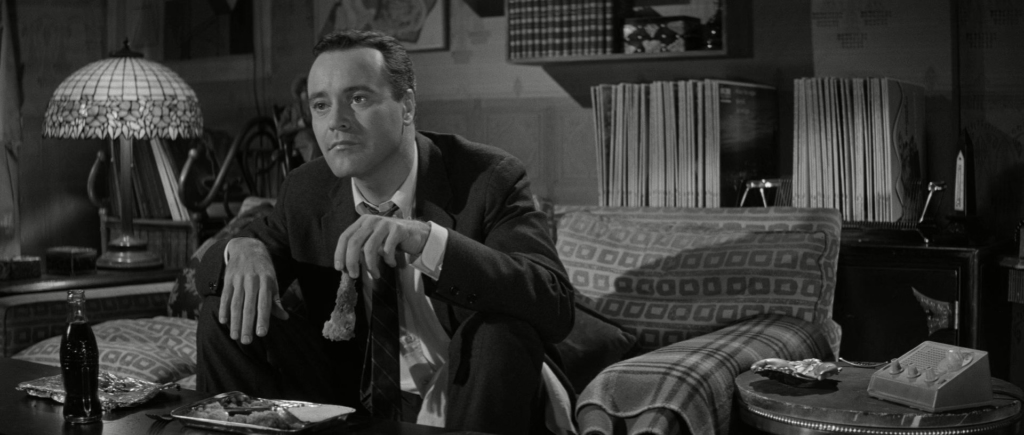
The plot hinges on a loony, rather absurd, barely plausible, idea: that an ordinary, nice, rational guy, who introduces himself by reeling off statistics on the population of New York City and the staff of the big insurance company he works for – his voice-over being played over impressive images of both the iconic cityscape and a typical desk-filled floor that sounds nearly more cartoonish than realistic – can willingly and even sheepishly accepts to let for a few hours his apartment to big shots of his company so they can entertain – and more – ladies who not their wives, which the main point for these lustful middle-aged men, even if it means he must spend endless hours away from his home at any time, working overtime, pacing in his home’s street chain-smoking, even, in a first, decisive, crisis, sleeping rough on a chilly night. He may be at times grumbling but, as a hilarious scene involving countless frantic calls he makes at this desk while blowing his nose after he caught a cold that night in a park, still readily accommodates his executives’ needs and wishes – a hotel clerk could not have been busier, warier, and yet more efficient.
The only, flimsy explanation C. C. Baxter can provide to Jeff D. Sheldrake, the company’s CEO who has found out about the sinful ways of his executives and does not seem pleased neither with their behaviors nor with the employee’s complicity, is that one day he did a pal the same kind of favor; it was the first time and the guy badly needed it and Baxter found it swell to help him; then a pal of this pal asked for the same service and Baxter did not think of any reason not to help him; and the word spread Baxter was willing to lend his place; and then the big shots were in the know and…
The smiling and mild-mannered guy has been caught in a system of his own making and did not dare to stop it and neither was he ready to acknowledge how foolish it was. And money does not explain everything. It is not just that his tenants are always late to pay back the costs. As he introduced himself, C. C. Baxter was quick to emphasize he is not over-ambitious and indeed, even as the unscrupulous executives put pressure on him by promising he is going to be promoted nothing indicates the nice guy is specifically more greedy and selfish than his colleagues. He may desire better wages but he desires even more not to displease and to stay out of trouble. And he simply does not know how to say no – and certainly not to his CEO who has actually summoned him not just to hear the truth but to ask a favor for himself.
In a way, the crisis-ridden romantic adventure C. C. Baxter is set to step in at this early point of his story is going to be a healthy learning curve: he would at long last say no at the end, even as he has reached the upper echelons of his company, deliberately drawing his career to an end and bidding goodbye to the titular place where the plot takes place more and more often. It is a belated, clumsy, but welcome, rebellion by a white collar who, like countless others, lives out of a routine made up of lot of work and even more of a lot of acceptance, compromise, and also tricks to fit in the American society’s social conventions. C. C. Baxter may be annoyed by the irresponsible and overbearing ways of the executives or by the consumerist and confident society he is part of – a funny sequence shows him eventually turning off his television than keep watching either western films or series he does not seem to like (which implies he does not recognize himself in the kind of brave manliness mass culture associates with the American experience) or a jovial presenter endlessly promoting the sponsors of a film that never seems close to be broadcast for good (perhaps to him, advertising is just a bore and a nuisance). But he is not a natural born rebel for sure.
It is not obvious that Fran Kubelik is the real thing. But the feisty elevator girl stands somehow apart in the mass of the company’s staff, and not just because of the uniform: her unusual though attractive haircut and her mischievous attitudes. Above all, she looks untouchable: to the despair of our gang of lustful executives, she resists getting picked up. Yet it is soon disclosed she fell for Jeff D. Sheldrake but left him, believing he would never divorce. However, the stern but seducing boss does feel something strong for her too and does not want to end the affair. That is why he wanted C. C. Baxter’s apartment and this is where the plot gets really teasing and thrilling: Fran Kubelik lets herself getting courted by her boss but at the same time feels more sympathy for C. C. Baxter who is falling for her, though he does not go very far because of his shyness and inability to woo ladies (as a comic scene in a bar with an equally drunken and depressed dame on a Christmas’ Eve suggests) or perhaps more accurately his lack of interest in wooing in the same systematic and obsessive manner as his company’s executives do.
For quite a long time, C. C. Baxter and Fran Kubelik do not realize they actually share the same apartment. But she loses an object at his home that he picks up and hands over to her lover who in turns gives it back to her. She then lends it then to C. C. Baxter who realizes the trouble he is – loving the girl of his boss. It is fitting the object is a pocket mirror which is broken: the shattered image it reflects is the perfect symbol of the hopelessly frustrating situation of the clerk as well, but he is not yet aware of the point, the elevator employee’s schizophrenic situation, loving a man she is aware may be deceiving her and just playing with her feelings and ignoring the true sentiment of another man she starts to like.
The film, while still delivering punching lines and funny misunderstanding and mischief, would briefly take the road of good old-fashioned melodrama, with an attempted suicide, to create a climax changing for the best the dynamics of the sentimental confusion. The apartment, shot more broadly, with a stronger grasp of perspective and dynamics, becomes a nest where a more genuine and enduring relationship seems able to thrive, quite different from the bachelor’s dull and careless routine and even more different from the superficial, short, raucous, and grotesque meetings between the executives and their dames.
This is also the place where the male lead character can appear as the help the lead female character needs and alter the visual hierarchy the film has displayed cleverly. The shot compositions have usually tended to put Fran Kubelik on the left side, making her the first person the eye meets, anchoring her as the real attraction cornering on the right the men, who must sometimes crane their head to talk with her, or look back over their shoulders when they move from the right to the left if they want to have any exchange with her. She may also holds firmly the center, radiant or downcast. But as she recovers from gulping too many sleeping pills, C. C. Baxter stands on the left side, or the center, stealing her place: now he is the one who calls the attention and she is comfortable with giving hers to him. He looks more than ever, and rightly, the real and happy owner of the place, no longer an amusing transient presence.
It would take still some time, and fresh hesitation on the part of Fran Kubelik still under the spell of her boss, before C. C. Baxter can fully prevail. But after a final crisis, the narrative’s happy ending can take place one last time in the apartment which is now partially emptied apartment after C. C. Baxter tendered his resignation. Associated with the lust and selfishness of his bosses, it has served its purpose: the new lovers just stay there to play a card game and drink the New Year’s champagne before making the fresh start both have been confusingly waited for and indeed deserve.
“The Apartment”, with the delicate sentiments of Fran Kubelik and the endless frustrations of C. C. Baxter, is a scathing rebuke of the manliness, authority, seduction a complacent society has attributed to corporate leaders. The great businessmen cast as role models and successful Americans, complete (but granted, it is with a touch of irony) with great physique and real feelings in the case of Jeff D. Sheldrake, are just pathetic womanizers quick to corrupt and to manipulate, a bunch of hypocrites proving the righteously conventional ways of the nation are based on unrealistic expectations about ethics and principles, and more crucially, a gang of dubious characters exploiting shamelessly the rest of their company’s workforce. Conversely, it is a bittersweet, wry and tender, celebration of more modest, less brilliant, characters who may look clumsy but whose feelings and pursuit of happiness lead them to a bumpy but inspiring journey. Romance to them is not self-evident and hard to gain but the battle makes them bolder and better. In this case, in their own ways, C. C. Baxter and Fran Kubelik have learned to say no to certain rules and individuals and find out what love could really mean. And this is no small victory.