
Turkey, Bulgaria, 2024
Directed by Zeki Demirkubuz
With Mirai Daner (Hicran), Burak Dakak (Riza), Umut Kurt (Mehmet, Hicran’s father), Melis Birkan (Hicran’s mother), Osman Alkas (Riza’s grandfather), Ozan Dagara (Riza’s uncle), Dogu Demirkol (Yilmaz), Seyit Nizam Yilmaz (Ferit), Kayhan Acikgoz (Yasar), Cem Davran (Orhan)
Unlike the dejected, wearied, and ashamed man who is the first to enter the frame, taken in a high angle shot and then observed in medium ones, Riza seems to take in his stride the disappearance of the young woman he has been engaged with. The first closeups on his cute boyish face clearly show he does certainly not intend to kill Hicran, the striking wish of the middle-aged fellow, which was even more striking to hear as the talk he had with Riza’s grandfather reveals he is her father.
Yet a visit to the brothel of the small rural community where Riza lives and works as a baker in the shop of his grandfather shows he may be far more preoccupied than it first sounded. Slowly, a kind of malaise grips the young man, who looks dreamy or exhausted, especially during a scene where he puts his bread to cook.
He eventually packs his suitcase and this shot cuts into a wholly different one, picturing Istanbul’s teeming streets. Follows a talk with an uncle living in the city disclosing Riza has set up there to look for Hicran.
Not much has been said, actually nothing, and the camera has just taken note of more and more confused behaviors and reactions and more and more absent-minded and melancholy stares and miens. The travel took place off-screen – but so did Hicran’s flee. A pattern has been set even as the narrative takes off slowly: what is really going on in the mind of the characters is left in large part inarticulate while the film barely lingers on what they do, especially if it is crucial. This latter aspect of the system would lead to an amazing climax, a decisive and tragic shooting altering the course of narrative arcs framed in such a way neither the violence nor the shooter are visible – though everything can be easily guessed; what is left is the stunned stare of a young woman, which pivots the film from Riza to Hicran.
Such a shift is not quite a surprise: the film has already demonstrated the ability to deliver twists and turns that are not quite what the audience could expect. The quest for Hicran through Istanbul has proved a baffling initiation to modern Turkey for the quite Riza: hosted by Yasar, a former schoolmate, he discovers how the cocky and cunning guy is misleading his parents and unashamedly exploits a student while having a good time in the city. Yasar has no qualms but strong views on how to make it by taking advantage of the great flaw of his fellow Turks, their innate desire to believe what they eagerly want to believe. Hypocrisy and brutality rule the world and he is proud to get it and act accordingly (look at his constant smirk).
However, unlike what the audience could now expect, this initiation does not last – the feature is not going to let Riza and the audience forget about the purpose of his unexpected and seemingly long-lasting travel and to focus on a wide examination of the nation. Thanks to links built with the police as he was searching for the lost fiancée, and his uncle’s connections, Riza has the opportunity to meet a pimp who could know what Hicran has become. The movie shift now away from the visitor to the Istanbul denizen, a bespectacled and limping young man, Yilmaz. It turns out that he lives with another pimp, Ferit, mainly busy with beating him and taunting him – odd ways to deal with a partner and a roommate (with the possibility more is at play between the two men). And that Hicran is with them. Fed up with Ferit’s cruelty, he tells everything to Riza, setting off a chain of events leading to the aforementioned killing.
Now “Hayat” strays fully away from the narrative arc of Riza to focus firmly and lastingly on Hicran’s. Still jumping over months or years without a hint, that part of the story starts with a homecoming which is like an ordeal, Mehmet, Hicran’s father, refusing to forgive her, attempting at first to beat her to death and then barely tolerating her presence at home – his distressed but stubborn daughter eventually settles down in an adjoining, abandoned house that is part of the family’s property. Her mother does what she can to support her, even if she ends up getting beaten by a husband clearly torn away by conflicting sentiments, with anger and sorrow undermining his balance religious zeal and hard work in the fields can barely buttress.
What it seems Hicran ran away from comes back again in her life: matchmakers prod her into marrying a man she does not know even as she is in no hurry to start a family. Orhan is in his late 50s and has retired from a job of professor but still work running a stationery shop; he is also the father of a young girl. Hicran’s mum makes her daughter understand she may not have much of a choice while her father does not care
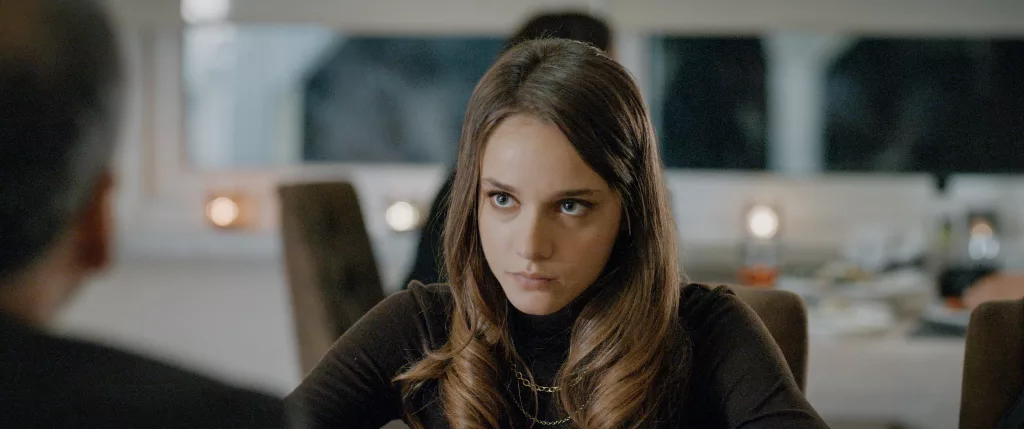
The film then cuts into a restaurant scene showing blatantly the huge gap between the temperaments of a fussing, self-obsessed middle-aged fellow and a younger lady who barely speaks but whose body and eyes convey ingrained reluctance and prudence. The trick is that the audience could think this is their first date: but the following scenes pointedly demonstrate the restaurant scene was just an ordinary scene of a married life – so Hicran did accept she had no choice, tied the knot, and has ever since struggled to fit in, with her husband disappointed by her inability to build closer, stronger, above all warmer, tenderer connections. The film now cruises into an uncanny, tense and awkward, but marked by genuine effort of comprehension and care, chronicle of a marriage on the verge of breaking apart.
Unsurprisingly, the spouses part ways and Hicran goes back home and breaks down, the editing featuring an extraordinary long and poignant scene of tears shed hysterically in a corner of the countryside. Surprisingly, the final part is centers on the reunion of Hicran and Riza, as the latter goes out of jail while the former was wondering what he has been feeling for years. And this time the bond that should have been sealed with the ceremony Hicran purposefully escaped gets really built: Hicran gives both Riza and marriage a second chance. And the film’s coda sounds like a perfect happy ending.
It is not thanks to such a conventional development that the film feels romantic. This quality is shaped by a more mysterious approach, a bold attachment to somehow subterranean and magical links and desires. Both the momentous decision of Riza to go to Istanbul to look for Hicran, even if he has not cared to know her better, and the no less dramatic urge of Hicran to get in touch after so many years with Riza, even if he killed the man who sheltered her, are preceded by odd dreams each makes of the other, dreams that deliberately mirror each other, a fascinating symmetry each time leading in the dream in the failure of the beloved to wake up from another world, while in the crude reality the dreamer wakes up brutally to act.
The tradition of matchmaking sounded at first under fire with the disappearance of Hicran and the failure of her marriage with Orhan labors the point self-obviously; yet it is the fleeting image of the promised spouse that ends up haunting the victims of the dealings between Riza’s grandfather and Hicran’s father; perhaps some fates, as fairy tales or legendary romances would have it, are truly deemed to collide and to stick together. After all, as Yasar told Riza, though still taking only account of his self-interest, there is a reason for people to cross paths – chance does not matter, destiny does.
Still, this destiny-shaped romance, even as it showcases at the end lovely and vibrant pictures of a happy and bright young couple, delivers a searing, view on a modern Turkey that remains depressingly mired on old, patriarchal, traditions, with women’s agency still a contentious issue and people’s satisfaction hinging on hypocrisy and conformism, even on the most superficial level. Resistance is nevertheless really possible.
What makes Orhan such a respectable and likable figure is that he is ready to stop pretending and to keep an unhappy marriage going on cruelly: unlike Mehmet, he accepts Hicran’s eagerness for free choice. What also sets Riza apart is that his curiosity and care for Hicran drives him to try to understand her and to free from a nefarious relation; being quite candid about the matchmaking process that sought to bond them allows him to build with Hicran a most sincere, genuine, strongly-felt bond that is no longer an arbitrary move to cope with. It has taken a long time – technically, a runtime of 160 minutes and an elaborate string of clever twists and turns complete with bold ellipses and potent sequences – to reach such an outcome.
It remains, of course, to be seen whether it could really last: after all, the film cuts into the end credits, with the shot on the couple fading into black, right when Hicran was to tell Riza about her last dream.. Maybe there are many things still buried deep in a character whose stare has often puzzled and worried the men around her, Ferit and Orhan nervously asking her why indeed she is staring at them the way she does. This is another riveting element of “Hayat” that still can vex the audience: Hicran’s intriguing and lasting opacity the film never full addressed.