
France, 1977
Directed by Pierre Schoendoerffer
With Jacques Perrin (Willsdorf, aka le Crabe-tambour), Claude Rich (the doctor), Jean Rochefort (the captain), Jacques Dufhilo (the chief engineer)
Wide shots on rusting shipwrecks stranded on a bleak seashore: these are the depressing images over which both the opening titles and the end credits appear. These shots impart right away the bitter feelings that long travels and great adventures must also end and would do so in the saddest way. This notion befits the story the film soberly tells, featuring three French Navy sailors whose fate is bound to be heartbreaking. They are a doctor, who once tried to be a civilian but enrolled again in the Navy because he could not do better, a captain who is making a last mission, and another officer the two other characters used to know and to respect, a dashing daredevil named Willsdorf but better known under the nickname of the Crabe-tambour (the word is explained this way: on the one hand his father liked to call people, including his relative, crabs, adding a qualifier; and on the other hand, Willsdorf as a child enjoyed tapping on his belly every time he ate a good meal; so the boy ended up being known as the drumming crab, to give an English translation).
Time past segues into time present endlessly, at the behest of a phrase thrown in the conversations the doctor has with the captain, but also with a few other persons, in particular the bigoted and blunt chief engineer of the frigate where the present of the narration takes place. The film becomes a puzzle of images which slowly, and a bit confusedly, discloses the Crabe-tambour’s amazing life and also carefully distillates as the frigate keeps sailing the torment and purpose of its captain.
The main film viewpoint’s is the doctor’s. His voice-over gives logbook-like information, depicting how long and harsh the voyage is. He stirs the conversations, bringing up to the surface wonderful as well as painful memories. He used to be a close friend of Willsdorf and tries to gather what the captain is up to; but he also stands as an interesting character on his own right, a keen observer and skilled man who has been bruised by life and feels nostalgia, though he retains an ironic lucidity.
The frigate’s sailing is a routine maneuver, to keep in shape the crew while they circumnavigate the French territory of Saint-Pierre-et-Miquelon and Canada’s Newfoundland to deliver mail and give a helping hand to French fishermen working around. It is obviously odd that an aging and respected captain would ask to lead such a mission to end his career, especially after a spell of inactivity. As it happens, piloting a trawler in this part of the Atlantic Ocean is the latest adventure of Willsdorf; and meeting him again after a break of many years is the real goal of the captain whose lungs are quickly destroyed by a cancer. The meeting takes place, but through radio contacts; the sole word they truly exchange speaks volume about the distance between them and the respect that has held them together for a long time; it underlines that past cannot be redeemed and end is always coming to us.
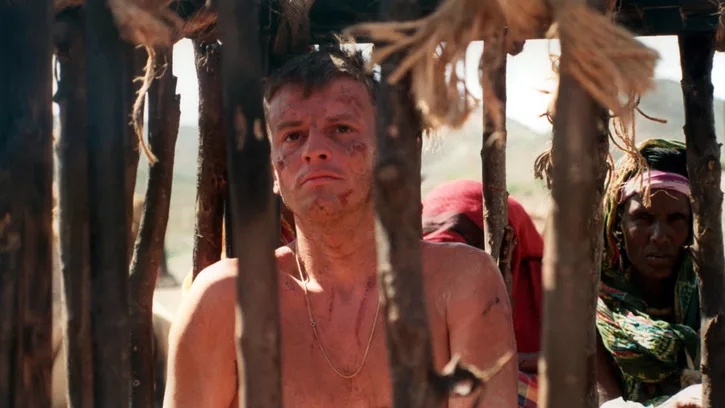
This is a story about the honor of the members of the military and the way they can handle the end of their life and the loss of many things. It is highly symbolic the voyage ends as radio broadcasts report the fall of Saigon and the final victory of Vietnamese Communists; this is the end of a world the three used to know, as their career landed them in the former French Indochina, though briefly for the captain. He would bump against the Crabe-tambour later, twice: first at sea, where Willsdorf, recently freed from a Vietnamese camp for prisoners of war and not yet back in the uniform, was sailing like an old-fashioned explorer on a junk, and later in Algeria, where their amity was wrecked by the crisis ravaging the territory. It is quite remarkable and courageous for a 1977 film to tackle the 1961 army rebellion that tried to disrupt the march to independence of this North African French colony in a rather non-judgmental way even as the titular character was clearly a sympathizer of this futile coup attempt. Willsdorf was tried and sentenced while the captain never resigned to show his support for his comrade: some words were uttered and proved enough to fuel resentment. What do honor, friendship, or conscience truly mean? And what are their prices? The doctor would dismiss the captain’s last stand before Willsdorf as pride; but is that simple?
The parable of talents the captain likes to quote at the end and that the chief engineer comments points to a more bitter truth which underpins the striking contrast between the adventures of the Crabe-tambour he sailed through with a radiant, brash, and relaxed persona and the duller careers and attitudes of the captain and also of the doctor. Willsdorf can be judged as an eccentric knight errant getting lost in the seven seas; but he exudes a vitality that courts exciting risks and calls for admiration (obviously by ladies). The fate which befalls his former comrades and their dissatisfaction with working life (a captain who grew unwilling to serve his Navy and a doctor who was unable to become a civilian professional) highlight how banal they were, in life and in temperament (and the lights duly emphasize the difference, with the wintry atmosphere wrapping the frigate so fully in stark contrast with the constant warm air and sun of Vietnam, the Pacific Ocean, the Horn of Africa, and Algeria). Who has wasted his talent at the end of the day?
The only problem which can be found in the otherwise elegant film, based on the eponymous novel the director had himself wrote, is that the montage is sometimes a rambling collection of anecdotes, some unrelated to the lead characters (in particular the stories about his native Brittany the chief engineer tells with a glass of cognac in hand). But the main story and its psychological and moral dimensions are engrossing and moving. The film’s success owes much to brilliant performances by actors Jacques Perrin, more seductive and passionate than ever, Claude Rich, always subtle and solid, and Jean Rochefort, who puts on a striking intensity. Matters too an awesome and powerfully designed cinematography by veteran director of photography Raoul Coutard (who has, like Jacques Perrin, a collaborator of Pierre Schoendoerffer for his groundbreaking war film “La 317ème section”, whose story is incidentally related to this one as it is revealed that the Crabe-tambour is the brother of the sergeant at the ore of the 1965 movie, an intertextual link underlining the import and values of memories born from war camaraderie).