
United States, 2010
Directed by Kelly Reichardt
With Michelle Williams (Emily Tetherow), Will Patton (Solomon Tetherow), Bruce Greenwood (Stephen Meek), Rod Rondeaux (the Indian), Zoe Kazan (Millie Gately), Paul Dano (Thomas Gately), Shirley Henderson (Glory White), Neal Huff (William White), Tommy Nelson (Jimmy White)
Under the blazing sun, in the middle of endless prairies, soon to be replaced by far more arid terrain, a man etches on a bleached dead trunk the word “Lost”. The previous images suggested as much, wide shots showing the distant group of individuals the guy belongs to trudging their ways in the hostile wild, crossing gingerly and wearily a river, folks, oxen, and wagons moving from right to left, the opposite of the usual western way of reading, a contradictory visual move on the screen fitting pioneers clearly facing contrariety in their travel through the lands of Oregon in the 1840s.
At this point of the Unites States history, gold rush had not yet turned California into a magnet and it was Oregon that sounded like a promised land, a cornucopia to be reaped, an adventure to be made to gain independence and well-being – the diaries of the men making the trek were clear enough about it and filled with enthusiasm. By contrast the diaries of the women who were with them, usually wives, also daughters, pointed to a completely different and subdued feeling, as they “complained about the long days of walking and the unending toil that marked their passage across the continent. In their diaries, they also confided their reluctance about leaving homes and friends behind and questioned the decisions made for them by husbands and fathers”, as historian Stephen Aron notes in his book “The American West: A Very Short Introduction” (Oxford University Press, 2015).
The unending toil and effort is plain to watch in the first images of this sparse and somber period piece. It is, indeed, a highly questionable decision that has led to the dire straits of the group, a terrible choice that actually gives the film its title: parting ways from a bigger caravan, Solomon Tetherow and his wife Emily, Thomas Gately and his wife Millie, and William White and his wife Glory and son Jimmy, have followed a rider, Stephen Meek, who told them he knew the territory well and could take them through a shortcut to the spot the caravan was moving to, giving them a head start of sorts. Trouble is, the shortcut looks plainly like a hopeless wandering through plains and mountains where greenery is sparse, and so could be water.
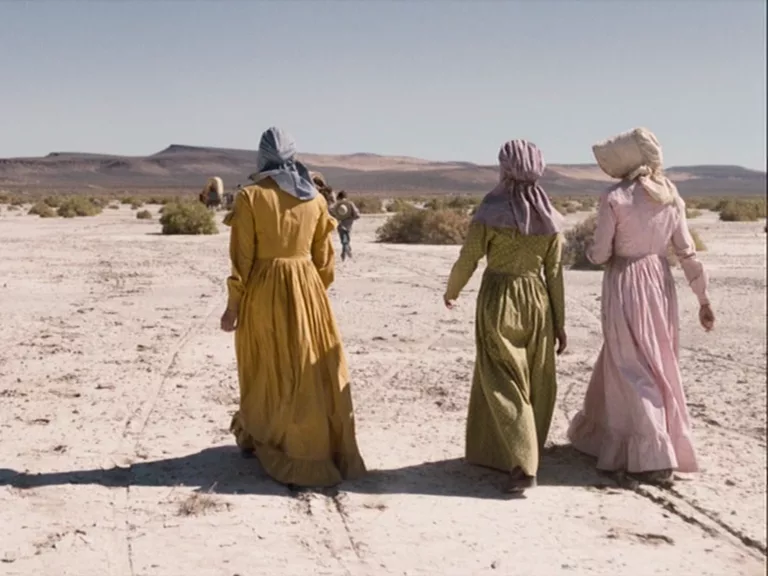
The pioneers would be torn over this plight of their own making and what to do about it all over the film. The women, as the film carefully shows, one composition after the other, are not invited to deliberate. They are doing the chores, liking picking up wood or knitting, and walk behind, even trekking together but at a distance, behind the three wagons. They can only guess what is going on: the worst, that is, but it seems they are unable, or unwilling, to influence the men, especially the blustering, hard-boiled guide. What was in the diaries examined by the historians gets in “Meek’s Cutoff” a vivid, genuine, sympathetic illustration. This western adventure is the tale of women trying to cope with the harsh environment and the dangers their foolhardy companions have rushed headlong into to get the better life they yearn for themselves.
And it clearly shows the toll the effort takes on the women: the dirt, the fatigue, the fraying nerves, the regrets. Mark this touching scene when one evening, as the travelers are eating around a campfire, with uncertainty greater than ever about what the next day could bring, frail Glory White, on the verge of breakdown, rhapsodizes on the pigs her father bred – a heartbreaking reminder, indeed, that these women did have a past, relatives, and memories, and did take a leap of faith by sticking with the men they married.
The turning point of their involuntary trek comes when Solomon Tetherow and Stephen Meek capture an Indian who was stalking the group, spooking one day Emily Tetherow. The latter is keen on killing him, since all Indians are probably a menace (the stark reminder here of what an oxymoron his name is) while the former (who conversely is deserving of his biblical first name) reckons the stranger could help them find the right way, at least to badly needed water resources. Solomon Tetherow prevails, and the film takes a fresh course increasingly and subtly: it is no longer the trigger-happy, self-proclaimed wise man, the shrewd and fake personality of Stephen Meek who shapes the journey, even less the reactions of the men who trusted them. The film examines how the Indian tries to adapt and how women cope with the new situation, in particular the straightforward, clear-eyed, brave wife of Solomon Tetherow.
No information is provided about the Indian, whose fellow tribesmen are never to materialize. The stubborn fellow is first silent and angry, but then gets used to his odd status of privileged prisoner and dubious guide, rambling about nature and the moon in his own words, which the film pointedly refuses to translate: the audience is as ignorant as the pioneers and forced to watch the events always wondering what could occur with no clues and plenty of speculation. The gap between the Indian and the Whites is plain to see and hard to bridge, at first sight. But then Emily Tetherow decides to give him food the first night, then to repair one of his shoes later, and eventually has a constant eye contact with him. Faced with this new, more dangerous situation, she rises to the challenge, and becomes bolder. The seething conflict with Stephen Meek comes to a head dramatically. To her, as a hushed dialogue by night with her husband hinted a few scenes after the beginning, Stephen Meek is just swaggering and faking – the Indian, by contrast, stands for a more concrete and truthful bond with the environment the pioneers wish to conquer, even if his culture is antagonistic.
When in the final sequence, around a tree that appeared unexpectedly, sign of a possible lushest ground, distorted echo of the tree of life depicted in the Bible William White and his wife keep endlessly reading, Stephen Meek declines to object anything and notes that is at the service of the group, he clearly names Emily Tetherow as the leader to be held accountable for the next step, even as the Indian keeps proceeding through the Oregon landscape. The tragic circumstances and a chance encounter have allowed in this case a woman to have the upper hand, a womanizing of the genre making up for the silence and the sacrifice that defined the women’s part in the building of the American union. Whether it is for the best or the worst is not clear: the film is chillingly open-ended, the last exchange of gazes between the American settler and the Native American offers no easy interpretation, the horizon reveals nothing. More than ever, to be a pioneer is a matter of life and death, risk and reward, victory or defeat, or more simply, highlighted by a splendid cinematography, a hard, dicey slog from the known world to a world yet to be known.