
United States, United Kingdom, Canada, 2024
Directed by Brady Corbet
With Adrien Brody (László Tóth), Felicity Jones (Erzsébet Tóth), Raffey Cassidiy (Zsófia), Alessandro Nivola (Attila), Guy Pearce (Harrison Lee Van Buren Sr.), Joe Alwyn (Harry Lee), Stacy Martin (Maggie Lee)
That an American movie feature is released including an intermission neatly splitting it in two distinct parts lasting in this case more or less the same time has been a rarity for a long time, but this is how “The Brutalist” comes up and bills itself, with a title card warning the intermission would come even before the titles sequence begins. The running time may be justifying the pause: it is some three hours and a half, but then other ambitious and outstanding films, American or not, have been released for years if not decades without the need for intermission (either designed by the producers or decided by the theaters).
Intermission is a concept more readily associated with theater or opera; the latter artistic form gets a nod fast as the film after the titles sequence proceeds with scenes labeled by a title card as an overture. It would end with an epilogue, still signaled by a title card, as were the first and second parts, the first having a title that is borrowed from a Vidiadhar Surajprasad Naipaul book – there is also an unmistakable literary quality in the way the film is made, with a sweep worthy of great novels of the 19th and 20th centuries and even the pervasive presence of the written words in a first part where letters received or sent play a role.
In more cinematic terms, even before the film started, a logo appears indicating it is shot in Vistavision, a wide frame ratio favored by director Alfred Hitchcock and a few others. The logo looks purposefully vintage: this is a blatant move back to an old form, a willful tribute to the era when moving pictures were made as big as possible, if only to keep the audience from getting glued to the small screens which were overtaking homes. And “The Brutalist” does look big, especially in the theaters where it is projected in 70 mm.
All those formal elements may sound technical details and a film should not be judged only on such things; they are still worthy of attention since they make plain how self-consciously ambitious and keenly eager to carry the audience away while fitting in some cinematic traditions the film is and advertises itself from the first to the last image. It nearly cries for praise and recognition as a brave new effort in the 21st century to be a serious and purposeful entertainment, lavish and intelligent, engrossing and illuminating.
It is perhaps all the keener to be appreciated as an impressive and inspiring work as it is built around a topic and a character cinema has not so often explored, the architectural creation and the challenged architect (an another American film consciously exploring them that readily comes to mind is of course “The Fountainhead”, 1949). As the title indicates, the narrative deals with the specific movement of brutalism, a stark style of functional architecture making use of steel and concrete in massive shapes whose name was coined at the time the story takes place, the 1950s. The film focuses on the struggles to design, to sell to investors, authorities, and the public, and even more to build with the right materials and staff, or more precisely the more bearable collaborative atmosphere, a massive and innovative brutalist building in a verdant and distant corner of Pennsylvania. And many scenes to be as truly gripping as astonishingly realistic down to the minutest detail.
Still, the lead character is built with a wider and fleshlier perspective in mind, making him easily relatable to the American audience. László Tóth is a migrant hoping in the wake of World War II to make it in a country viewed as a promised land and a radical rupture from a native Hungary which was a Fascist regime allied to Nazi Germany and is now set to become a Communist regime. This matters even more for a Jew who barely escaped the worse – a member of a persecuted minority trying his luck in a multicultural society sounding so appealing and reassuring from afar. Things over the years, however, do not play out as he wishes and the complex, at first comforting and then catastrophic, relation with the patron the talented architect has met, Harrison Lee Van Buren Sr., makes for a powerful and persuasive tale echoing lasting and popular talking points about the role and influence of that towering trademark figure of the American imagination and identity the highly successful, enlightened and yet ruthless, industrialist is, and bout the perennially fraught but unavoidable relation between art’s ambitions and money’s demands.
There is an essential element of romance too, which is not only the predictable and poignant part of the narrative recipe but effectively what organizes the narrative. The two parts, from 1947 to 1953 and then from 1953 to 1960, turn out to be defined not just by László Tóth’s fate, first the rise from misery to a lucky assignment saddled with challenges and troubles and then the long-winded and frustrating battle to get the building built, spanning two distinct periods and sparking an ugly confrontation between the artist and the patron, humbling the former but ultimately destroying the latter. It is another kind of emotions that matter.
Of a rawer nature they spring from the deep bond between László Tóth and his wife Erzsébet Tóth, who is first an absence despairing the loving husband, a wife still trapped in the mayhem of postwar Hungary sending and receiving letters highlighting their urge to get reunited and the difficulties to achieve the goal, and then a vibrant, supportive but suffering, resolute but fragile, presence after she has been successfully brought to America with the right status in the company of her husband’s niece, the quiet and devoted Zsófia. How the couple deals with the experience of migration and adaptation, how it can strengthen the bond before fraying it, how his expectations about her and her vision about his new life shape their behaviors and relations to the wider world are as overriding and engrossing as the narrative’s other points.
Intimacy and activity, the personal identity and the bustling environment, what the lead is and what his new land is often overlap in bold editing moves not only swinging from one imagery to another but with sounds getting mixed to stunning effect. Archival images purposefully highlight the distinct identity of Pennsylvania, cast as the quintessential of the American experience, spirit, and more precisely, economic prowess in the 1950s are deftly woven into the grimmer fabric of László Tóth’s rise, the prospect of success sounding far harder to get that the migrant can imagine and yet still having some truth. Key moments blend the effort, not always rewarded by fate, of getting built the community center Harrison Lee Van Buren Sr. overnight decided to have as a tribute to his late mother (and his family’s fortune) and as a gift to the town where he resides (and that he dominates), with moving scenes conveying the most personal aspects of László Tóth, from his religious fervor, like attending the synagogue’s prayers, to his care for his wheelchair-bound wife.
This is where the sweep of a great novel and the cinematic vision of a life involved in history in the making and society in full transformation prove not just engaging but brilliant. Yet there is an odd limit. Apart from occasional radio bulletins, little is said about American politics and actually little is showed about the society the migrants deal with on a daily basis; at the same time, the film pays extensive attention to the situation of the Jews, chronicling the impact of the creation of Israel, which would be a fault line breaking the bond between Zsófia and her relatives. The 20th century great plight of the Jews, the Nazi-organized genocide, is even defined in the film’s epilogue as the real inspiration of the architect, in a narrative twist which is quite belated and truly hard to find convincing, rationally and symbolically.
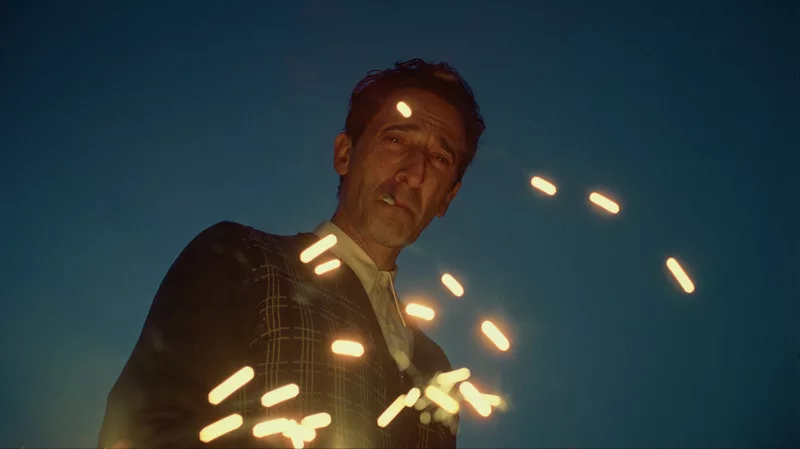
On a more, and more decisively, intimate level, the film and his lead actor, Adrien Brody, deeply convincing in his tortured and passionate ways, his stubbornness and his fragility, always eager and edgy, flawlessly bringing to life the complicated and heartbreaking personality of his fictional character (there has never been a real László Tóth, though he has been inspired by real Hungarian architects), deliver an unsparing but fascinating portrait of a talent unable to compromise, scathingly lucid, prone to anger, with the love for his wife the best part of his temperament, till the challenge of starting over the building’s construction proves to big a challenge. He is an amazing and compelling brilliant mind and that is part of his seduction as well as his legacy – the film ends with a coda set in 1984 in an exhibition celebrating in Venice his career.
But if he catches the attention of an irritable and impulsive industrialist and managed to get along with him it is not without ambiguity. How aware of what wealth and power mean and the prejudices and excesses they hold get clearly spelled out in his cutting repartees with the big man’s son, Harry Lee, who is actually the one who first noticed him when he wished with his sister Maggie Lee to refurbish the father’s studio in his palace as he dealt with Attila, a furniture seller and László Tóth’s distant relative who helped the migrant settle down. But the ambiguity is even stronger with Harrison Lee Van Buren Sr. himself, who seems incredibly supportive till later nastier feelings corrode his views and drives him to assert his power cruelly.
The dreadful moment, shot in a grisly chiaroscuro, feeling even more sordid because of the context (after a party in the mountains where the famous Carrara marble quarries are) is the crucial turning point. And the more far-fetched element of the screenplay. This unexpected use of homosexuality to cast another, uglier but no less key aspect of the character, begs belief and stands as a too crude and sudden symbol of the negative feelings the businessman has. It starts a rush to wrap up in highly spectacular and intense manner a story that has been running for a long time and those final moments only make you feel how something has been missing all along. And it may be that sense of deeper angst and passion, the possibility of glancing into abyss, of groping more burning crannies and nooks, of getting though stares and acts real vertigo, not only to ascertain evil but also to vibrate with generosity or beauty. There is at the end of the day something like a lack of liberty and energy in those characters and torments. The film may have been too self-conscious, too eager to play perfectly by a perfect textbook, too willing to show the way to the audience and to stick with them thanks to the carefully calibrated images and editing moves, to be the real great thing it pretends. “The Brutalist” is really good, praiseworthy and deserving success, and yet it is not quite as exhilarating as a masterwork usually is.