
France, Italy, 1968
Directed by Claude Chabrol
With Stéphane Audran (Frédérique), Jacqueline Sassard (Why), Jean-Louis Trintignant (Paul Thomas), Henri Attal (Robègue), Dominique Zardi (Riais)
This may be simply the story of an elegant and costly black coat, a disturbing narrative arc beginning when it appears in the first shots on a Paris bridge, worn by a walking woman and ending when it features in the final shots up worn by a woman lying on a bed, a different woman nevertheless claiming to be the same in a creepy finale far darker than the haughty, predatory, quirky feelings the first scene conveyed, hinting how uncanny and unnerving the first woman was.
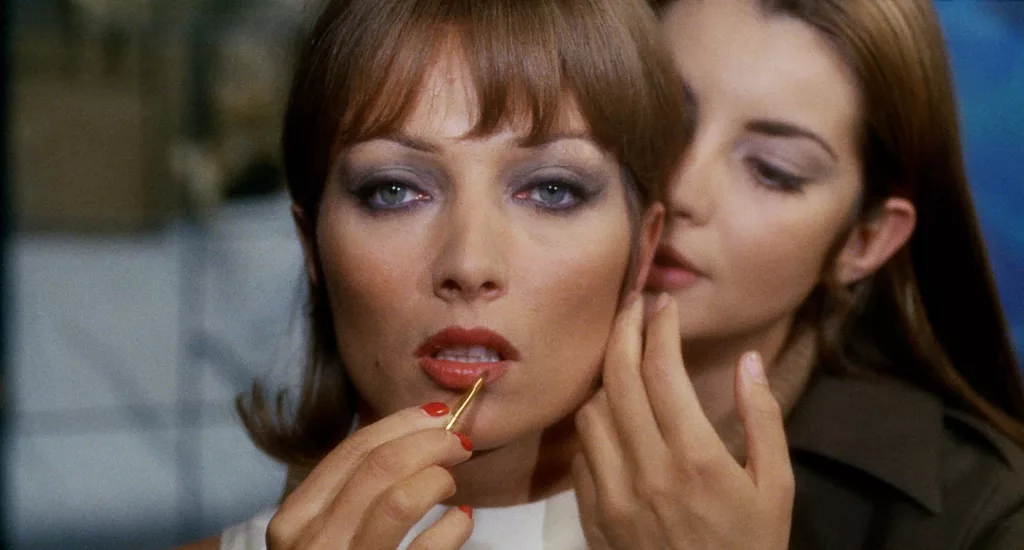
She is clearly as wealthy and powerful as she looks arrogant and assertive in her elegant and costly black coat, but it is not just her rakish, slightly sultry, allure that sets her apart. Decisively, she offhandedly drops a big banknote on the spot where a younger, far less well-dressed, woman is drawing to earn some money even as passers-by tend either to ignore the street artist or just throw small coins. Once the drawing is deemed finished, the young woman asks her elder what has been her point. The first lines, the tone, the attitudes, point at a clash between two strong, resolute, toxic characters, the snob’s provocative moves causing scathing attacks by an awkward loser just as equally proud and fearless. Frédérique, the black-clad lady, still coaxes Why, the denim-clad girl, into coming into her posh apartment. Relations keep being fraught but images, conveying the viewpoint of Frédérique, suggest ambiguity and perversity. The prologue concludes with an unmistakably eroticism.
The story then moves to Saint-Tropez, Frédérique’s lair where she manages a yachting business and owns a sprawling estate. This is first the chronicle of a very special lesbian affair, Why accepting despite her pig-headed and thin-skinned temperament to be the docile partner of Frédérique, her feminine gigolo, enjoying the luxury of her mistress quietly even if she acknowledges she is not sure to love really Frédérique and even to be truly a lesbian, or a human keen on loving and fucking (when asked whether she enjoys sex she answers she does not know, startling her mistress). Days fly by fast, defined by a fair weather, lovemaking, the parties thrown in the house, and the antics of the two men Frédérique bizarrely hosts all along the year in her house, two very old and intimate friends who are absurdly prankish and incredibly zany given their age and who could be as delightfully entertaining as awfully tiresome, Robègue and Riais.
But during one party things take an unexpected turn, when a new guest, architect Paul Thomas, stares at Why and demonstrates without much restrain and without pretending to act politely otherwise how thrilled by her he is. Why accepts, once the party is over, to follow him and spends the rest of the night with him. It is enough to cause Frédérique to feel jealous and to confront the architect. But the clash once again leads to an amazingly ambiguous and perverse game. Frédérique seems to impose on the others a threesome and then decides to travel with Paul Thomas, leaving Why on her own. When Frédérique is back, she makes clear she has an affair with Paul Thomas – and does not try to stay close to Why, without, however, breaking up with her and forcing her to push off – quite the contrary.
The novel and embarrassing situation does upset Why, unsurprisingly. But the big clash comes from Riais and Robègue who simply cannot stand Paul Thomas (he is not great fan of their eccentricities either). Both men end up evicted by an ill-tempered Frédérique. Now, they are only three of them in the house and an odd threesome relationship blooms, with Why shockingly and disturbingly enjoying the role of a servant, a companion, a flirt too to the two others – but still banned from Frédérique’s bedroom. When the couple must go away because of a pressing business the architect must cope with, things take another, far more unsettling, turn. The few strange behaviors Why had now like precursors to the deep crisis of identity and sentiments she experiences in her solitude. The only solution would be to try and getting reunited with the others – or even to put an end to their ungrateful and selfish attitudes. A knife would be enough for the job.
How shockingly ironic the title is. Since Antiquity, when the animal was associated with goddess Diana and praised by Celts as a god’s messenger, the doe (the English for biche) has been considered a symbol of love, purity, and delicacy, the graceful emblem of a true, sensitive, and fragile womanhood, an animal inviting to pleasant dreams, thoughtful ideas, and romantic hopes. At first glance, drawing does could hint at a soft and tranquil character: the first surprise is to find out that Why is such a disruptive and blunt woman. The second surprise is that the drawing sets off an unconventional relationship the French society, and the wider Western world, was not ready in the 1960s to tolerate much – even less actually when Frédérique’s unpalatable character is taken into account as well as Why’s strange behaviors. And of course the third and overwhelming surprise is how this story evolves into a frightening psychological drama and then horror.
Maybe then the doe was a fitting symbol: always drawing the animal, Why, despite her prickly and proud side, was perhaps craving for love and care, an innocence awkwardly hiding behind self-made barricades fearing to be touched by the wrong hands and fake sentiments when she is aiming at a purity in her own terms. But then again what she comes up with under pressure is baffling and disturbing: striving to imitate the woman who initiated her into exciting, unconventional, but rewarding, love and lovemaking, seemingly to convince her to keep her, perhaps too to get the architect’s attention again, unless far more confused and far darker impulses are at play. There remains a degree of opacity that makes the case of Why hard to grasp long after the film is over. What is clinically demonstrated, through alarming scenes deftly edited, with a startling work on the voices, is that Why decides to be Frédérique: more than an imitation, the conviction she is the perfect double, a dead ringer destined to complement the other’s life. When rejected, killing the original would be the obvious choice – and it is not certain the man at the core of the crisis can survive much longer as the new Frédérique waits for him in that elegant and costly black coat.
Then the doe maybe not just an apt symbol: it stands as the ultimate perversion and real madness, the symbol of a schizophrenia bringing about an apocalypse, a frightening self-transformation irremediably self-destructive. The ghost of Alfred Hitchcock directing troubling films like “Spellbound” (1946) or “Psycho” (1960) is hovering over yet another lacerating depiction of the French bourgeoisie and small-town life by director Claude Chabrol tackling contentious social issues (homosexuality and social and financial inequity) while daring to mix it with a dreadful descent of a character into hell as she proves unable to define her sentiments and to deal with the complexities of love (even though he arguably runs the risk of too readily associating homosexuality and insanity, an association that has been too often made in the past to dismiss and discriminate LGBT people). A doe Why may could have been, a wolf she ends up being.